Very scary assessment of the world economy.
Monday, 27 October 2008

Friday, 24 October 2008
Investment: The Calm Before The Storm
Financial crisis: demand for gold soars as price tumbles
Investors have rushed to buy gold bars and bought exchange traded funds, worth US$2.8 billion – the biggest inflow on record.

Good as gold: investor demand for gold remains high Photo: EDDIE MULHOLLAND
The onset of a global recession and falling stock markets have triggered a stampede for gold – the traditional safe haven during times of uncertainty.
According to the World Gold Council, exchange traded funds are the main beneficiary of the flight to safety. ETFs experienced their strongest quarterly inflow during the third quarter since SPDR®Gold Shares – the first gold ETFs - were launched in November 2004.
But the Council added that bullion dealers around the world reported an unprecedented surge in demand for coins and small bars. It said that there had been reports outright shortages of gold and high premiums over the gold spot price. The US Mint temporarily suspended sales of American Buffalo gold 1 ounce coins after its stocks were depleted, while UK, German and Austrian coin dealers have also reported an enormous increase in demand during the third quarter, it added.
The average gold price edged down slightly between June and September, to $870.88/oz, from $896.11/oz in the previous three months. Gold traded as high as $986/oz on July 15, the day after the US Treasury and Federal Reserve Bank announced plans for a joint bail-out of mortgage giants Fannie Mae and Freddie Mac, but fell sharply later in the quarter to a low of $740.75/oz on September 11. This proved short lived, however. By the end of the quarter, the gold price had rebounded to $884.50/oz.
Yesterday, gold was trading at $729.20 an ounce after hitting intraday low of $718.20 -- its lowest level since September 2007.
There is an increasingly wide range of methods available to investors wanting to buy gold or gain exposure to gold price movements – from gold coins to complex structured financial products
Exchange-traded funds
These are not technically funds because they follow a single security. ETF gold securities are traded on the London Stock Exchange. They essentially track the gold price and can be traded daily – all you pay is the dealing charge of around 0.4 per cent. They are also regulated financial products. Visit www.exchangetradedgold.com or www.etfsecurities.com for more information.
Unit trusts and investment trusts
These are few and far between, the most popular being BlackRock Merrill Lynch Gold & General, which invests in the shares of gold mining companies as well as other commodity businesses. Advisers reckon general commodity funds could also do the job for private investors as they dabble in gold-related stocks – JPM Natural Resources and ACDS Australia Natural Resources remain popular. Gold mining equities tend to be more volatile than the gold price.
Coins and small bars
Bullion coins and small bars offer private investors an attractive way of investing in relatively small amounts of gold and they are exempt from VAT. Bullion coins and small bullion bars contain a minimum of 99.5 per cent fine gold. Gold bars start at around pounds 39 for a 2.5g bar, rising to pounds 11,957 for a 1kg bar. Visit bullion dealers such as Baird & Co (www.goldline.co.uk).
Gold accounts
Gold bullion banks offer two types of gold account – allocated and unallocated. An allocated account is effectively like keeping gold in a safety deposit box and is the most secure form of investment in physical gold. The gold is stored in a vault owned and managed by a recognised bullion dealer or depository.
With an unallocated account, on the other hand, investors do not have specific bars allotted to them. Traditionally, one advantage of unallocated accounts has been the absence of any storage or insurance charges, because the bank reserves the right to lease the gold out.
Economics: Fed Funds Rate Vs Inflation
 The Federal Reserve uses the fed funds target rate to implement monetary policy, raising the rate to curb inflation and cutting it to stimulate economic growth. The chart shows the Fed is having difficulty keeping the actual effective rate in line with its target, suggesting a half-point cut at next week’s FOMC meeting is likely.
Aggressive Fed cuts have taken its target rate down to 1.5%, well below the official 4.9% inflation rate. Interest rates approaching zero and hundreds of billions of bailout dollars flying off the printing presses at the Treasury have only one implication… higher INFLATION is coming.


Tuesday, 21 October 2008
Economics: Keyser Soze Returns...
With thanks to Knotty...
Deflation Scare the Perfect Camouflage | ||||
|

It is said the market can sniff out prospective problems and price itself accordingly. If so, then someone needs to get this dog some nasal spray, lickedy-split!
The deflation scare currently hovering over the entire market, particularly in the metals and commodities sectors, has been brutal. But the key question today is whether this “scare” will evolve into a genuine deflation threat to the US and the world?
Inflation and deflation are monetary phenomenons. Monetary inflation occurs when the supply of money increases faster than the supply of goods and services. This is different from the concept of price inflation, which, depending on several variables that may impact inputs along a given production chain, can cause an increase in the price level for certain goods and services at any given time. Otherwise said, monetary inflation causes price inflation, but a price rise isn’t always a result of monetary inflation.
With monetary deflation you have the opposite effect, in that it relates to a contraction in the money supply. If the supply of money contracts, while the supply of goods and services either remains constant, increases, or contracts at a slower rate, then that can lead to price deflation. Otherwise said, a contraction in the supply of money will in most cases cause asset prices to fall, but falling asset prices are not always the result of a monetary deflation (the oil price can rise if the supply of oil is falling at a faster rate than a money supply contraction, for instance).
What we have today is falling asset prices in, specifically, real estate and stocks, and a rise in the value of the US dollar. This has led many to wrongfully conclude that we are not only experiencing a deflation scare, but that a depression brought on by a deflationary collapse is imminent.
I don’t see it that way. Stocks and real estate are collapsing because the US was on a debt binge for many years. Given that real estate purchases are mainly financed by debt, and that many have used margin in stock portfolios, as well as, in the cases of hedge funds and others, dangerously high levels of leverage, the deleveraging that was forced upon the market following the collapse of debt instruments tied to bad loans is what is causing the dramatic declines in these asset prices today.
In a fiat money world with governments controlling the money printing presses you can be sure those governments will do everything in their power to fight off depressions. Anyone who continues to doubt this must have been living under a rock the past couple of months.
With much of the world holding the same toxic instruments and in similar, but not as horrific shape as the US, the ability of the US Treasury to tap its foreign creditors and borrow its way, to the tune of trillions, out of this mess has been severely impacted. On the domestic front, the savings rate is approximately zero, and increasing levels of unemployment will cause tax receipts to collapse. The only alternative will be the printing of money.
The US is the world’s greatest debtor. Money printing will bring on monetary inflation, which will wipe out those debts, savings, as well as the US dollar. That is the real scare that markets today, as well as foreign creditors, should be pricing in. It is only a matter of time. To borrow a line from the classic film ‘The Usual Suspects’: The greatest trick the Devil ever pulled was convincing the world he didn't exist.
Christopher G. Galakoutis
CMI Ventures LLC
Westport, CT, USA
Monday, 20 October 2008
Investment:Swimming Against The Tide By Gareth Milliams
In every great crisis there is great opportunity. Two weeks ago we bought UltraShort ETF's and returned 40% within a week. Whilst fortunate, it wasn't luck. It was judgement. Judgement based upon probability.
As you may have seen in a previous post, we succesfully shorted the Russell 2000 Value Index and the Dow Jones Basic Materials Index. We went in, made a profit and left. Veni, Vidi, Vici. We came, we saw, we conquered. On to the next thing.
My point is this; because a market is negatively volatile and over emotional, it doesn't mean that you have to be part of its collective defeatism.
One of the reasons why I have not posted for 11 days is that there has been so much incorrect and misleading information in this event driven market, that the smart thing was to not commit to any particular position. I was predominately in cash, so therefore my market view was neutral. I wanted to observe.
It was only when the Chicago Board of Exchange Volatility Index which considers above 30 as volatile started registering 55+ that we shorted the Russell 2000. I believe that in a credit crunch, mid-caps will always have greater liquidity issues than the big corporations. So we went in with (depending on the clients wishes) between 10 & 20% of total portfolio value.
The trick was to sell whilst the market was still going down. A weekend is an eternity in this toxic environment, so Friday seemed apt. It also proved fortuitous.
There are going to be other times to make money in this recession. Again, we will refuse to get caught up with market hysteria and will look for opportunities that present themselves rather than chase that which cannot be caught.
As you may have seen in a previous post, we succesfully shorted the Russell 2000 Value Index and the Dow Jones Basic Materials Index. We went in, made a profit and left. Veni, Vidi, Vici. We came, we saw, we conquered. On to the next thing.
My point is this; because a market is negatively volatile and over emotional, it doesn't mean that you have to be part of its collective defeatism.
One of the reasons why I have not posted for 11 days is that there has been so much incorrect and misleading information in this event driven market, that the smart thing was to not commit to any particular position. I was predominately in cash, so therefore my market view was neutral. I wanted to observe.
It was only when the Chicago Board of Exchange Volatility Index which considers above 30 as volatile started registering 55+ that we shorted the Russell 2000. I believe that in a credit crunch, mid-caps will always have greater liquidity issues than the big corporations. So we went in with (depending on the clients wishes) between 10 & 20% of total portfolio value.
The trick was to sell whilst the market was still going down. A weekend is an eternity in this toxic environment, so Friday seemed apt. It also proved fortuitous.
There are going to be other times to make money in this recession. Again, we will refuse to get caught up with market hysteria and will look for opportunities that present themselves rather than chase that which cannot be caught.
Friday, 10 October 2008
Investment: How My Clients Make Money In the Worst Market In History By Gareth Milliams
It takes a combination of research, timing, client and advisor trust as well as balls to make profits in this market environment. But we are doing just that right now.
The portfolios are simple:
Cash
Gold Bullion
Short ETF's
The weightings vary according to client. But thats of little import. What matters is that my clients are making money.
Ultra Short Russell 2000
Purchase Price Of Ultra Short Russell 2000: $94.53
Purchase Date: 6/10/2008
Price as of 9/10/2008: $129.00
Return of 36.46%
Ultra Short Basic Materials
Purchase Price of Ultra Short Basic Materials: $76.20
Price as of 9/10/2008: $90.50
Return of 18.77%
I am tempted to sell but with a major recession looming, I feel that Basic Materials and the mid cap Russell 2000 can continue to be shorted for a while yet...
The portfolios are simple:
Cash
Gold Bullion
Short ETF's
The weightings vary according to client. But thats of little import. What matters is that my clients are making money.
Ultra Short Russell 2000
Purchase Price Of Ultra Short Russell 2000: $94.53
Purchase Date: 6/10/2008
Price as of 9/10/2008: $129.00
Return of 36.46%
Ultra Short Basic Materials
Purchase Price of Ultra Short Basic Materials: $76.20
Price as of 9/10/2008: $90.50
Return of 18.77%
I am tempted to sell but with a major recession looming, I feel that Basic Materials and the mid cap Russell 2000 can continue to be shorted for a while yet...
Sunday, 5 October 2008

Tuesday, 30 September 2008
Investment: Schadenfreude
I have nothing but sympathy for people who have lost money through mismanagement of their portfolio. But I can't help but breathe a sigh of relief and internally smile for my personalised portfolio clients.
It ain't easy being in cash and mistakes were made in December last year. But today we were proven right.
Unlike many, we can sleep easy at night...
It ain't easy being in cash and mistakes were made in December last year. But today we were proven right.
Unlike many, we can sleep easy at night...
Monday, 29 September 2008
The Bail-Out: A Perspective On Cost
6 Billion people in the world.
The bail out will cost $700 billion.
The cost of the bailout is therefore $116 for every human being on earth.
The bail out will cost $700 billion.
The cost of the bailout is therefore $116 for every human being on earth.
Sunday, 28 September 2008
Simon Jenkins: A tribunal must tell us what to fix. And whom to punish
The state shirked its role while City stupidity and greed slid into thieving. When the crisis subsides, an inquiry is needed.
Who are they? Where are they now? They said it could not happen again. They said they were masters of the universe. They had conquered history itself and had that wily monster quivering at their feet. There would be no more crashes, no more recessions, no more booms and busts, just moonbeams and rainbows and jam for tea.
If the mistakes that have collapsed the world's financial markets had been made by statesmen and had led to war, there would be corpses swinging from lampposts. If they had been made by generals, they would be falling on their swords. If they had been made by judges or surgeons or scholars, some framework of professional retribution would be rolling into action. But those responsible for our finances can apparently vanish into the forest like Cheshire cats, leaving only gold-plated grins. Not for them a Hague tribunal or a Hutton inquiry. They are not just good at shedding risk - they shed blame.
We are seeing what historians of ideas call a paradigm shift. In the last century, the necessities of war and the rise of socialism thrust government intervention to the fore. When that failed in the 60s and 70s, the "Reagan-Thatcher revolution" turned the emphasis back to private enterprise and deregulation. That era has ended with astonishing abruptness. Governments in Britain and the US have been nationalising and spending public money with a will that would have made Attlee or Roosevelt blush.
Those of us who learned economics in the old days were taught that banks had to be regulated oligopolies because their role in a capitalist economy was crucial. It relied on the sustenance of public trust which only government, backed by the citizen as taxpayer, could dispense. In Britain, retail banks, merchant banks and building societies were legally distinct, separated by barriers to prevent cross-pollution of the sort that caused the 1929 crash.
JK Galbraith's book on that crash is the Dr Strangelove of financial holocaust. If it offers one lesson, it is that crashes are not acts of God; they are caused by the interaction of corporate behaviour and state regulation. Nor does the market supply its own discipline. Understanding that, wrote Galbraith, "remains our best safeguard against recurrence".
Such lessons learned in youth tend to stick. Hence I remember feeling queasy when Thatcher's "big bang" of 1986 demolished the firewalls and permitted the trading of risk and reward across the entire financial sector. It was a reform repeated in the US with the repeal of the post-depression Glass-Steagall law. The same nervousness greeted each subsequent shock to the system - the 1991 housing crash, Lloyd's of London, Barings, Enron, Northern Rock. Each time we were assured that new lessons had been learned. Light-touch regulation was working fine, even if sometimes boys will be boys.
The naivety of all this is now exposed. Politicians encouraged the public to treat home ownership as a "right"; property became the citizen's gilt-edged stock. Bankers encouraged staff to speculate with depositors' money by awarding them huge bonuses to maintain turnover. Those charged with the guardianship of other people's savings behaved, in effect, like thieves. Sheer greed drove young men and women mad. Nobody in authority batted an eyelid.
At the same time Gordon Brown "set free" the Bank of England to fix interest rates. I recall one commentator telling me that I should be "overjoyed your children and grandchildren will now never have to experience inflation". No, they are just unemployed. It was a charade. On the back of low inflation, the Bank fuelled a credit boom that was clearly vulnerable if prices rose and/or credit collapsed. Both have occurred.
There is no such thing as a "non-political" official rate of interest. The Bank is now under pressure both to cut rates to beat recession, and yet raise them to beat inflation. It cannot do both. Since it would be 1929-style lunacy to increase rates just now, Brown must in effect tell the Bank to reduce them by shifting his inflation target. It is a blatant and properly political decision.
There is no perfect market. Markets need regulation, just as communities need law. Yet as Galbraith again wrote, regulators may start life "vigorous, aggressive, evangelical, even intolerant", but mellow with age and become "an arm of the industry they are regulating - or senile".
To ignore the danger in 125% mortgages or the City bonus culture showed both industry capture and senility. The first was loan-sharkery, and the second was obscene. So distorting to sound finance are year-end bonuses that they should simply be banned. Those with the responsibility of gambling with other people's savings should do so on salary.
While naive Thatcherism may have taken a pasting, there is no reason why capitalism should protest the presence of big government in what is its proper realm. We do not curb state power when the security of the state is at risk. Nor should we do so when the security of the economy is equally jeopardised.
The strangest phenomenon these past few days has been the eagerness to enforce "moral hazard", a concept regarded by the governor of the Bank of England as a deterrent to risk-taking. This is absurd. The collapse of Enron was no deterrent to Lehman derivative traders. The psychology of money does not work that way. The victims of the credit crunch are not just a few wild traders. They are all participants in the UK economy. I cannot see the sense in letting Northern Rock or Lehman or any other deposit-holding institution go bust just so regulators who have failed in their jobs can seem macho after the event.
This is not a question of blowing taxpayers' money on fat cat financiers. I would happily arrest and try all those whose stupidity and greed are about to cause untold hardship to millions - if I could find a law they had broken. Dr Johnson was quite wrong to say a man is "never more innocently employed than in getting money". But when a building collapses, you do not kill the architect. You try to get him to build it again.
Underpinning financial credit is an absolute function of government and one that has not changed since the birth of capital. It clearly needs constant redefinition. When this saga is through there should be a tribunal of inquiry. Then we can be told what needs mending, and whom to take out and shoot.
Who are they? Where are they now? They said it could not happen again. They said they were masters of the universe. They had conquered history itself and had that wily monster quivering at their feet. There would be no more crashes, no more recessions, no more booms and busts, just moonbeams and rainbows and jam for tea.
If the mistakes that have collapsed the world's financial markets had been made by statesmen and had led to war, there would be corpses swinging from lampposts. If they had been made by generals, they would be falling on their swords. If they had been made by judges or surgeons or scholars, some framework of professional retribution would be rolling into action. But those responsible for our finances can apparently vanish into the forest like Cheshire cats, leaving only gold-plated grins. Not for them a Hague tribunal or a Hutton inquiry. They are not just good at shedding risk - they shed blame.
We are seeing what historians of ideas call a paradigm shift. In the last century, the necessities of war and the rise of socialism thrust government intervention to the fore. When that failed in the 60s and 70s, the "Reagan-Thatcher revolution" turned the emphasis back to private enterprise and deregulation. That era has ended with astonishing abruptness. Governments in Britain and the US have been nationalising and spending public money with a will that would have made Attlee or Roosevelt blush.
Those of us who learned economics in the old days were taught that banks had to be regulated oligopolies because their role in a capitalist economy was crucial. It relied on the sustenance of public trust which only government, backed by the citizen as taxpayer, could dispense. In Britain, retail banks, merchant banks and building societies were legally distinct, separated by barriers to prevent cross-pollution of the sort that caused the 1929 crash.
JK Galbraith's book on that crash is the Dr Strangelove of financial holocaust. If it offers one lesson, it is that crashes are not acts of God; they are caused by the interaction of corporate behaviour and state regulation. Nor does the market supply its own discipline. Understanding that, wrote Galbraith, "remains our best safeguard against recurrence".
Such lessons learned in youth tend to stick. Hence I remember feeling queasy when Thatcher's "big bang" of 1986 demolished the firewalls and permitted the trading of risk and reward across the entire financial sector. It was a reform repeated in the US with the repeal of the post-depression Glass-Steagall law. The same nervousness greeted each subsequent shock to the system - the 1991 housing crash, Lloyd's of London, Barings, Enron, Northern Rock. Each time we were assured that new lessons had been learned. Light-touch regulation was working fine, even if sometimes boys will be boys.
The naivety of all this is now exposed. Politicians encouraged the public to treat home ownership as a "right"; property became the citizen's gilt-edged stock. Bankers encouraged staff to speculate with depositors' money by awarding them huge bonuses to maintain turnover. Those charged with the guardianship of other people's savings behaved, in effect, like thieves. Sheer greed drove young men and women mad. Nobody in authority batted an eyelid.
At the same time Gordon Brown "set free" the Bank of England to fix interest rates. I recall one commentator telling me that I should be "overjoyed your children and grandchildren will now never have to experience inflation". No, they are just unemployed. It was a charade. On the back of low inflation, the Bank fuelled a credit boom that was clearly vulnerable if prices rose and/or credit collapsed. Both have occurred.
There is no such thing as a "non-political" official rate of interest. The Bank is now under pressure both to cut rates to beat recession, and yet raise them to beat inflation. It cannot do both. Since it would be 1929-style lunacy to increase rates just now, Brown must in effect tell the Bank to reduce them by shifting his inflation target. It is a blatant and properly political decision.
There is no perfect market. Markets need regulation, just as communities need law. Yet as Galbraith again wrote, regulators may start life "vigorous, aggressive, evangelical, even intolerant", but mellow with age and become "an arm of the industry they are regulating - or senile".
To ignore the danger in 125% mortgages or the City bonus culture showed both industry capture and senility. The first was loan-sharkery, and the second was obscene. So distorting to sound finance are year-end bonuses that they should simply be banned. Those with the responsibility of gambling with other people's savings should do so on salary.
While naive Thatcherism may have taken a pasting, there is no reason why capitalism should protest the presence of big government in what is its proper realm. We do not curb state power when the security of the state is at risk. Nor should we do so when the security of the economy is equally jeopardised.
The strangest phenomenon these past few days has been the eagerness to enforce "moral hazard", a concept regarded by the governor of the Bank of England as a deterrent to risk-taking. This is absurd. The collapse of Enron was no deterrent to Lehman derivative traders. The psychology of money does not work that way. The victims of the credit crunch are not just a few wild traders. They are all participants in the UK economy. I cannot see the sense in letting Northern Rock or Lehman or any other deposit-holding institution go bust just so regulators who have failed in their jobs can seem macho after the event.
This is not a question of blowing taxpayers' money on fat cat financiers. I would happily arrest and try all those whose stupidity and greed are about to cause untold hardship to millions - if I could find a law they had broken. Dr Johnson was quite wrong to say a man is "never more innocently employed than in getting money". But when a building collapses, you do not kill the architect. You try to get him to build it again.
Underpinning financial credit is an absolute function of government and one that has not changed since the birth of capital. It clearly needs constant redefinition. When this saga is through there should be a tribunal of inquiry. Then we can be told what needs mending, and whom to take out and shoot.
Economics: A Bail Out Constructed By Lawyers
It seems to matter not to the politicians who are constructing a bail-out not primarily for the folks on Main Street but designed to get them re-elected to Congress or elected to the White House.
Who cares what the professionals at the Federal Reserve and the Treasury Department believe is the best solution to the greatest threat in nearly 80 years to the world economy.
There will be a bail-out and it will pass the House. But it will be a pale version of what could have been on Thursday.
Lets just hope (in vain?)that common sense will prevail...
Who cares what the professionals at the Federal Reserve and the Treasury Department believe is the best solution to the greatest threat in nearly 80 years to the world economy.
There will be a bail-out and it will pass the House. But it will be a pale version of what could have been on Thursday.
Lets just hope (in vain?)that common sense will prevail...
Thursday, 25 September 2008
The Bail-Out: The Complete Text
Quite possibly the most important text of the 21st century thus far:
Text of Draft Proposal for Bailout Plan
LEGISLATIVE PROPOSAL FOR TREASURY AUTHORITY
TO PURCHASE MORTGAGE-RELATED ASSETS
Section 1. Short Title.
This Act may be cited as ____________________.
Sec. 2. Purchases of Mortgage-Related Assets.
(a) Authority to Purchase.--The Secretary is authorized to purchase, and to make and fund commitments to purchase, on such terms and conditions as determined by the Secretary, mortgage-related assets from any financial institution having its headquarters in the United States.
(b) Necessary Actions.--The Secretary is authorized to take such actions as the Secretary deems necessary to carry out the authorities in this Act, including, without limitation:
(1) appointing such employees as may be required to carry out the authorities in this Act and defining their duties;
(2) entering into contracts, including contracts for services authorized by section 3109 of title 5, United States Code, without regard to any other provision of law regarding public contracts;
(3) designating financial institutions as financial agents of the Government, and they shall perform all such reasonable duties related to this Act as financial agents of the Government as may be required of them;
(4) establishing vehicles that are authorized, subject to supervision by the Secretary, to purchase mortgage-related assets and issue obligations; and
(5) issuing such regulations and other guidance as may be necessary or appropriate to define terms or carry out the authorities of this Act.
Sec. 3. Considerations.
In exercising the authorities granted in this Act, the Secretary shall take into consideration means for--
(1) providing stability or preventing disruption to the financial markets or banking system; and
(2) protecting the taxpayer.
Sec. 4. Reports to Congress.
Within three months of the first exercise of the authority granted in section 2(a), and semiannually thereafter, the Secretary shall report to the Committees on the Budget, Financial Services, and Ways and Means of the House of Representatives and the Committees on the Budget, Finance, and Banking, Housing, and Urban Affairs of the Senate with respect to the authorities exercised under this Act and the considerations required by section 3.
Sec. 5. Rights; Management; Sale of Mortgage-Related Assets.
(a) Exercise of Rights.--The Secretary may, at any time, exercise any rights received in connection with mortgage-related assets purchased under this Act.
(b) Management of Mortgage-Related Assets.--The Secretary shall have authority to manage mortgage-related assets purchased under this Act, including revenues and portfolio risks therefrom.
(c) Sale of Mortgage-Related Assets.--The Secretary may, at any time, upon terms and conditions and at prices determined by the Secretary, sell, or enter into securities loans, repurchase transactions or other financial transactions in regard to, any mortgage-related asset purchased under this Act.
(d) Application of Sunset to Mortgage-Related Assets.--The authority of the Secretary to hold any mortgage-related asset purchased under this Act before the termination date in section 9, or to purchase or fund the purchase of a mortgage-related asset under a commitment entered into before the termination date in section 9, is not subject to the provisions of section 9.
Sec. 6. Maximum Amount of Authorized Purchases.
The Secretary’s authority to purchase mortgage-related assets under this Act shall be limited to $700,000,000,000 outstanding at any one time
Sec. 7. Funding.
For the purpose of the authorities granted in this Act, and for the costs of administering those authorities, the Secretary may use the proceeds of the sale of any securities issued under chapter 31 of title 31, United States Code, and the purposes for which securities may be issued under chapter 31 of title 31, United States Code, are extended to include actions authorized by this Act, including the payment of administrative expenses. Any funds expended for actions authorized by this Act, including the payment of administrative expenses, shall be deemed appropriated at the time of such expenditure.
Sec. 8. Review.
Decisions by the Secretary pursuant to the authority of this Act are non-reviewable and committed to agency discretion, and may not be reviewed by any court of law or any administrative agency.
Sec. 9. Termination of Authority.
The authorities under this Act, with the exception of authorities granted in sections 2(b)(5), 5 and 7, shall terminate two years from the date of enactment of this Act.
Sec. 10. Increase in Statutory Limit on the Public Debt.
Subsection (b) of section 3101 of title 31, United States Code, is amended by striking out the dollar limitation contained in such subsection and inserting in lieu thereof $11,315,000,000,000.
Sec. 11. Credit Reform.
The costs of purchases of mortgage-related assets made under section 2(a) of this Act shall be determined as provided under the Federal Credit Reform Act of 1990, as applicable.
Sec. 12. Definitions.
For purposes of this section, the following definitions shall apply:
(1) Mortgage-Related Assets.--The term “mortgage-related assets” means residential or commercial mortgages and any securities, obligations, or other instruments that are based on or related to such mortgages, that in each case was originated or issued on or before September 17, 2008.
(2) Secretary.--The term “Secretary” means the Secretary of the Treasury.
(3) United States.--The term “United States” means the States, territories, and possessions of the United States and the District of Columbia.
Text of Draft Proposal for Bailout Plan
LEGISLATIVE PROPOSAL FOR TREASURY AUTHORITY
TO PURCHASE MORTGAGE-RELATED ASSETS
Section 1. Short Title.
This Act may be cited as ____________________.
Sec. 2. Purchases of Mortgage-Related Assets.
(a) Authority to Purchase.--The Secretary is authorized to purchase, and to make and fund commitments to purchase, on such terms and conditions as determined by the Secretary, mortgage-related assets from any financial institution having its headquarters in the United States.
(b) Necessary Actions.--The Secretary is authorized to take such actions as the Secretary deems necessary to carry out the authorities in this Act, including, without limitation:
(1) appointing such employees as may be required to carry out the authorities in this Act and defining their duties;
(2) entering into contracts, including contracts for services authorized by section 3109 of title 5, United States Code, without regard to any other provision of law regarding public contracts;
(3) designating financial institutions as financial agents of the Government, and they shall perform all such reasonable duties related to this Act as financial agents of the Government as may be required of them;
(4) establishing vehicles that are authorized, subject to supervision by the Secretary, to purchase mortgage-related assets and issue obligations; and
(5) issuing such regulations and other guidance as may be necessary or appropriate to define terms or carry out the authorities of this Act.
Sec. 3. Considerations.
In exercising the authorities granted in this Act, the Secretary shall take into consideration means for--
(1) providing stability or preventing disruption to the financial markets or banking system; and
(2) protecting the taxpayer.
Sec. 4. Reports to Congress.
Within three months of the first exercise of the authority granted in section 2(a), and semiannually thereafter, the Secretary shall report to the Committees on the Budget, Financial Services, and Ways and Means of the House of Representatives and the Committees on the Budget, Finance, and Banking, Housing, and Urban Affairs of the Senate with respect to the authorities exercised under this Act and the considerations required by section 3.
Sec. 5. Rights; Management; Sale of Mortgage-Related Assets.
(a) Exercise of Rights.--The Secretary may, at any time, exercise any rights received in connection with mortgage-related assets purchased under this Act.
(b) Management of Mortgage-Related Assets.--The Secretary shall have authority to manage mortgage-related assets purchased under this Act, including revenues and portfolio risks therefrom.
(c) Sale of Mortgage-Related Assets.--The Secretary may, at any time, upon terms and conditions and at prices determined by the Secretary, sell, or enter into securities loans, repurchase transactions or other financial transactions in regard to, any mortgage-related asset purchased under this Act.
(d) Application of Sunset to Mortgage-Related Assets.--The authority of the Secretary to hold any mortgage-related asset purchased under this Act before the termination date in section 9, or to purchase or fund the purchase of a mortgage-related asset under a commitment entered into before the termination date in section 9, is not subject to the provisions of section 9.
Sec. 6. Maximum Amount of Authorized Purchases.
The Secretary’s authority to purchase mortgage-related assets under this Act shall be limited to $700,000,000,000 outstanding at any one time
Sec. 7. Funding.
For the purpose of the authorities granted in this Act, and for the costs of administering those authorities, the Secretary may use the proceeds of the sale of any securities issued under chapter 31 of title 31, United States Code, and the purposes for which securities may be issued under chapter 31 of title 31, United States Code, are extended to include actions authorized by this Act, including the payment of administrative expenses. Any funds expended for actions authorized by this Act, including the payment of administrative expenses, shall be deemed appropriated at the time of such expenditure.
Sec. 8. Review.
Decisions by the Secretary pursuant to the authority of this Act are non-reviewable and committed to agency discretion, and may not be reviewed by any court of law or any administrative agency.
Sec. 9. Termination of Authority.
The authorities under this Act, with the exception of authorities granted in sections 2(b)(5), 5 and 7, shall terminate two years from the date of enactment of this Act.
Sec. 10. Increase in Statutory Limit on the Public Debt.
Subsection (b) of section 3101 of title 31, United States Code, is amended by striking out the dollar limitation contained in such subsection and inserting in lieu thereof $11,315,000,000,000.
Sec. 11. Credit Reform.
The costs of purchases of mortgage-related assets made under section 2(a) of this Act shall be determined as provided under the Federal Credit Reform Act of 1990, as applicable.
Sec. 12. Definitions.
For purposes of this section, the following definitions shall apply:
(1) Mortgage-Related Assets.--The term “mortgage-related assets” means residential or commercial mortgages and any securities, obligations, or other instruments that are based on or related to such mortgages, that in each case was originated or issued on or before September 17, 2008.
(2) Secretary.--The term “Secretary” means the Secretary of the Treasury.
(3) United States.--The term “United States” means the States, territories, and possessions of the United States and the District of Columbia.
Wednesday, 24 September 2008
The Markets-Conspiracy?
This post will be deleted as soon as it looks TOO ridiculous, but is it not strange that Warren Buffet buys into Goldman Sachs, before a deal to rescue the banks is done? $5,000,000,000 invested in one tranche at a very high price for that stock, before we (or he) know the terms of the deal.
It seems out of character. What if there is no agreement? What then?
It seems out of character. What if there is no agreement? What then?
Monday, 22 September 2008
The Markets: Henry Paulsen Interview with Tom Brokaw
Henry Paulsen was interviewed for Meet The Press. Because of who he is and where we are in history, this interview is important. Additionally Michael Bloomberg and the guys of CNBC give their two penneth worth.
Sunday, 21 September 2008
Investment: Keynes Lives
"Only a crisis, real or perceived, produces real change. When that crisis occurs, the change depends on the ideas that are lying around. That, I believe, is our basic function: to develop alternatives to existing policies, to keep them alive and available until the politically impossible becomes politically inevitable".
Milton Friedman
This last week has been the most economically historic since 1929. We have witnessed a paradigm shift not just in global banking but in western style capitalism itself. Financial darwinism appears to be dead. The New Deal has been revitalised by the Neo-Conservative Bush Administration with a $50 billion insurance for money market mutual funds. This is after guaranteeing $85 billion for AIG, nationalising Fanny Mae and Freddie Mac and creating a $700 billion line of credit in order to buy worthless mortgages off the books of near bankrupt financial institutions.
The rescue package document that has been sent today to Congress is just 2 1/2 pages long. The lack of detail means that the powers given to the Treasury Secretary will probably be sweeping and wide ranging.
It is not though, the first time that the US government has intervened with the 'free markets'. In 1932, Herbert Hoover chartered the Reconstruction Finance Corporation (RFC). But it only became an effective force a year later when Roosevelt merged it with the Federal Insurance Deposit Corporation (FDIC) as part of the New Deal. It took 25 years and World War Two before it was finally abolished.
All this from the people who believe that any regulation is bad regulation and that the government should not intervene in peoples lives.
Until this week, Keynesian theory was discredited and had been largely abandoned in western Europe and the United States until the collapse of Northern Rock. Whilst initially criticised by many in the UK, its nationalisation did pave the way for the US bail outs.
So my questions are these:
1. Who will benefit from all this governmental largesse? Will it be extended beyond Wall Street and the Federal banks to local lenders. America has 7,200 banks beyond the likes of Goldman Sachs and JP Morgan. If Lehmans was allowed to fail, why should Comerica and Nations Bank survive?
2. How will they define 'at risk'? At what height will the bar be set?
3. AIG was pricing assets up to 2.7 times higher than its counterparty, Lehman Brothers. If such a pricing disparagy is common practice, then how will the government calculate true value?
4. How transparent will the process be and who will run it?
5. Is this the end of the credit crisis?
Nobody can answer the first four of these questions with any certainty. My worry is that the markets will shrug off these massive injections of cash and concentrate on the potential negative effects such as higher inflation and a possible dollar collapse due to the printing of new money.
So who will pay for it? Initially, China and Japan via T-Bills. But ultimately it is the American tax payer who will be footing the bill when the creditor nations look for their return on yield.
This isn't over. Not by a long way. My worry is that the White House is not throwing enough good money after bad. That the $700 billion is an optimistic under estimate of a situation that is far worse than presently appears. We still have to deal with the so-called 'synthetic' CDO's such as credit default swaps that have potential writedowns of up to $1700 billion and the Alt-A mortgages that Barclays Capital warned us about last week have a potential downside of another $1,000 billion.
Let's assume that the rules of real world economic's still exist. Just printing this much money to support the financial infrastructure is in itself inflationary. It will lead to a reduction in the value of the dollar which in turn could push up the cost of oil per barrel. This will lead to higher food prices as the cost of processing and transportation increases.
I may be wrong and I hope that I am.
So how to invest money in a market such as this?
Regular Premium:
Existing clients with large capital should look to hold either cash (US$) or for an asset that has long term growth prospects such as JPMF Natural resources. This fund invests in gold, mining and oil. The commodity market is oversold, Opec has reduced output and there will be a global recovery fueled by the assets that this fund invests in.
New plans and new money from existing investments should look to take advantage of the market volatility by dollar cost averaging with emerging funds from the BRIC nations and South East Asian Tigers. These economies whilst hit hard by the downturn in western markets do not have the structural issues that beset the 'developed' world. Buying them now on a regular basis with a 3 year view will prove highly profitable.
Personal Portfolios
Simple. Hold lots of cash and some bullion. Accumulate slowly. Ignore short term movements and look for trends. Watch the oil price. Remember that it is better to be a little late than to be too early.
Look for what powers an economy rather than the economy itself. By the time that equities gets back to profitability, the commodity market will have retraced back to its all time highs.
In an earlier blog I said that the first 20 years of the last 19th and 20th centuries dictated how those era's played out. We are at the epoch of the 21st century, which has seen 9-11, Katrina, the rise of China as a world power and the fall (temporary or otherwise) of the western banking system.
It is a magnificent opportunity.
Investment is changing.
Milton Friedman
This last week has been the most economically historic since 1929. We have witnessed a paradigm shift not just in global banking but in western style capitalism itself. Financial darwinism appears to be dead. The New Deal has been revitalised by the Neo-Conservative Bush Administration with a $50 billion insurance for money market mutual funds. This is after guaranteeing $85 billion for AIG, nationalising Fanny Mae and Freddie Mac and creating a $700 billion line of credit in order to buy worthless mortgages off the books of near bankrupt financial institutions.
The rescue package document that has been sent today to Congress is just 2 1/2 pages long. The lack of detail means that the powers given to the Treasury Secretary will probably be sweeping and wide ranging.
It is not though, the first time that the US government has intervened with the 'free markets'. In 1932, Herbert Hoover chartered the Reconstruction Finance Corporation (RFC). But it only became an effective force a year later when Roosevelt merged it with the Federal Insurance Deposit Corporation (FDIC) as part of the New Deal. It took 25 years and World War Two before it was finally abolished.
All this from the people who believe that any regulation is bad regulation and that the government should not intervene in peoples lives.
Until this week, Keynesian theory was discredited and had been largely abandoned in western Europe and the United States until the collapse of Northern Rock. Whilst initially criticised by many in the UK, its nationalisation did pave the way for the US bail outs.
So my questions are these:
1. Who will benefit from all this governmental largesse? Will it be extended beyond Wall Street and the Federal banks to local lenders. America has 7,200 banks beyond the likes of Goldman Sachs and JP Morgan. If Lehmans was allowed to fail, why should Comerica and Nations Bank survive?
2. How will they define 'at risk'? At what height will the bar be set?
3. AIG was pricing assets up to 2.7 times higher than its counterparty, Lehman Brothers. If such a pricing disparagy is common practice, then how will the government calculate true value?
4. How transparent will the process be and who will run it?
5. Is this the end of the credit crisis?
Nobody can answer the first four of these questions with any certainty. My worry is that the markets will shrug off these massive injections of cash and concentrate on the potential negative effects such as higher inflation and a possible dollar collapse due to the printing of new money.
So who will pay for it? Initially, China and Japan via T-Bills. But ultimately it is the American tax payer who will be footing the bill when the creditor nations look for their return on yield.
This isn't over. Not by a long way. My worry is that the White House is not throwing enough good money after bad. That the $700 billion is an optimistic under estimate of a situation that is far worse than presently appears. We still have to deal with the so-called 'synthetic' CDO's such as credit default swaps that have potential writedowns of up to $1700 billion and the Alt-A mortgages that Barclays Capital warned us about last week have a potential downside of another $1,000 billion.
Let's assume that the rules of real world economic's still exist. Just printing this much money to support the financial infrastructure is in itself inflationary. It will lead to a reduction in the value of the dollar which in turn could push up the cost of oil per barrel. This will lead to higher food prices as the cost of processing and transportation increases.
I may be wrong and I hope that I am.
So how to invest money in a market such as this?
Regular Premium:
Existing clients with large capital should look to hold either cash (US$) or for an asset that has long term growth prospects such as JPMF Natural resources. This fund invests in gold, mining and oil. The commodity market is oversold, Opec has reduced output and there will be a global recovery fueled by the assets that this fund invests in.
New plans and new money from existing investments should look to take advantage of the market volatility by dollar cost averaging with emerging funds from the BRIC nations and South East Asian Tigers. These economies whilst hit hard by the downturn in western markets do not have the structural issues that beset the 'developed' world. Buying them now on a regular basis with a 3 year view will prove highly profitable.
Personal Portfolios
Simple. Hold lots of cash and some bullion. Accumulate slowly. Ignore short term movements and look for trends. Watch the oil price. Remember that it is better to be a little late than to be too early.
Look for what powers an economy rather than the economy itself. By the time that equities gets back to profitability, the commodity market will have retraced back to its all time highs.
In an earlier blog I said that the first 20 years of the last 19th and 20th centuries dictated how those era's played out. We are at the epoch of the 21st century, which has seen 9-11, Katrina, the rise of China as a world power and the fall (temporary or otherwise) of the western banking system.
It is a magnificent opportunity.
Investment is changing.
Thursday, 18 September 2008
The Markets:The Aliens Are Fleeing
 | September 17, 2008 |

Foreign buyers exited the market for U.S. dollar-denominated debt and securities when the credit crisis surfaced in August of 2007. And their return since is proving to be somewhat tentative, as revealed in the latest U.S. Treasury report on capital flows. In July 2008, foreigners once again fled the scene, and were net sellers in U.S. capital markets to the tune of $25.6 billion.
The stability of U.S. credit markets relies on foreigners recycling their trade surpluses back into the U.S. economy by purchasing dollar-denominated IOUs. As large financial institutions continue to tumble, and the Fed turns on the printing press in an attempt to limit the damage, the flight to safety will mean a flight from the dollar and further trouble for U.S. markets.
Wednesday, 17 September 2008
The Markets: Lehman, AIG etc etc
"First of all, let's recognize that this is a once-in-a-half-century, probably once-in-a-century type of event," Alan Greenspan, ABC News, September 2008.
My God I hope so. In Tokyo today, Lehman staff have free access to telephones and printers in order to be able to phone around for jobs and to prepare their CV's. HR departments and headhunters are buckling under a deluge of applications and senior staff at other banks are suffering from righteous paranoia as some of Lehman's top people get cherry picked for plum jobs.
Lehman are a little like the ordinary victims of the sub-prime crisis, asset rich, cash poor and going broke. Like us ordinary people, Lehman have to cover their losses and debts, but the losses made thus far this year are so massive that the cash flow dried up.
Last weekend there was much talk of Bank of America putting together a merger package to help rescue Lehman. But to no avail. A prettier girl came to the dance called Merrill Lynch and she was willing to bend over backwards for BoA. Lehman was ignored, like a soon to be bankrupt wallflower.
BoA believe that the merger can bring them back to profitability by 2010. We'll see.
"This is a crisis. A large crisis. In fact, if you've got a moment, it's a twelve-story crisis with a magnificent entrance hall, carpeting throughout, 24-hour porterage and an enormous sign on the roof saying 'This Is a Large Crisis!" Edmund Blackadder, 16th century wit and coward.
The felling of Lehman led inevitably to AIG. Earlier in September, AIG had announced $13bn in losses for the first half of 2008. As Lehman Brothers suffered a major decline in value and share price, potential investors began to compare the types of securities held by AIG to those held by Lehman, and found that AIG had valued their ALT-A and sub-prime mortgage-backed securities at rates 1.7 to 2.0 times those Lehman had used for what Lehman officials called similar securities.
On September 14, 2008, AIG announced it was considering selling its aircraft leasing division, International Lease Finance Corporation in an effort to raise necessary capital for the company.
The Federal Reserve hired Morgan Stanley to determine if there were systemic risks to a failing AIG, and has asked private entities to supply short-term "bridge" loans to the company. In the meantime, New York regulators approved AIG for $20 billion in borrowing from its subsidiaries. On September 16th, AIG's stock dropped 60 percent at the market's opening. The Federal Reserve continued to meet that day with major Wall Street investment firms to broker a deal to create a $75 billion line of credit to the company. Rating agencies Moody's and Standard and Poors, meanwhile, downgraded their ratings on AIG's credit on concerns over continuing losses to mortgage-backed securities, forcing the company to deliver collateral of over $10 billion to certain creditors. The New York Times later reported that talks on Wall Street had broken down and AIG may file for bankruptcy protection on Wednesday, September 17th.
Conversely, sources in the U.S. Federal Reserve told The New York Times that the bank intended to loan the insurer US$85 billion in exchange for an 80% stake. This would be a similar deal to that given to Fannie Mae and Freddie Mac and would be based upon a federal conservatorship.
However, unlike Fannie and Freddie there is no Federal element to AIG, however the commitment is for two years. Unfortunately some of the positions will not mature until after then. But I think that the government may pull out before two years if the market becomes more stable and Moody's and S&P see fit to raise their credit rating. I also think that former AIG CEO and Wall Street Legend, Hank Greenberg could be in the mix as a safe pair of hands.
This is not gloating. But back in June this year, I quoted a Daily Telegraph article about an RBOS report:
"A very nasty period is soon to be upon us - be prepared," said Bob Janjuah, the bank's credit strategist.
A report by the bank's research team warns that the S&P 500 index of Wall Street equities is likely to fall by more than 300 points to around 1050 by September as "all the chickens come home to roost" from the excesses of the global boom, with contagion spreading across Europe and emerging markets.
I commented:
"Hopefully, you have already rigged for the financial typhoon that RBS and Morgan Stanley are now joining us in predicting. Don’t forget to warn your friends".
Since then despite being tempted by boredom and percieved inaction to 'do' something, I have held my lump sum portfolio clients investments in cash with an underweight position in the GLD etf.
Nobody knows what is happening in these markets from minute to minute. There is talk of a serious drop in the price of oil and gold; massive capital outflows in the emerging markets and further eruptions and aftershocks within the global financial infrastructure.
All of these may or may not be true. But what I do know is that once the dust has begun to settle, opportunities will begin to avail themselves to us. We just have to know where to look.
My God I hope so. In Tokyo today, Lehman staff have free access to telephones and printers in order to be able to phone around for jobs and to prepare their CV's. HR departments and headhunters are buckling under a deluge of applications and senior staff at other banks are suffering from righteous paranoia as some of Lehman's top people get cherry picked for plum jobs.
Lehman are a little like the ordinary victims of the sub-prime crisis, asset rich, cash poor and going broke. Like us ordinary people, Lehman have to cover their losses and debts, but the losses made thus far this year are so massive that the cash flow dried up.
Last weekend there was much talk of Bank of America putting together a merger package to help rescue Lehman. But to no avail. A prettier girl came to the dance called Merrill Lynch and she was willing to bend over backwards for BoA. Lehman was ignored, like a soon to be bankrupt wallflower.
BoA believe that the merger can bring them back to profitability by 2010. We'll see.
"This is a crisis. A large crisis. In fact, if you've got a moment, it's a twelve-story crisis with a magnificent entrance hall, carpeting throughout, 24-hour porterage and an enormous sign on the roof saying 'This Is a Large Crisis!" Edmund Blackadder, 16th century wit and coward.
The felling of Lehman led inevitably to AIG. Earlier in September, AIG had announced $13bn in losses for the first half of 2008. As Lehman Brothers suffered a major decline in value and share price, potential investors began to compare the types of securities held by AIG to those held by Lehman, and found that AIG had valued their ALT-A and sub-prime mortgage-backed securities at rates 1.7 to 2.0 times those Lehman had used for what Lehman officials called similar securities.
On September 14, 2008, AIG announced it was considering selling its aircraft leasing division, International Lease Finance Corporation in an effort to raise necessary capital for the company.
The Federal Reserve hired Morgan Stanley to determine if there were systemic risks to a failing AIG, and has asked private entities to supply short-term "bridge" loans to the company. In the meantime, New York regulators approved AIG for $20 billion in borrowing from its subsidiaries. On September 16th, AIG's stock dropped 60 percent at the market's opening. The Federal Reserve continued to meet that day with major Wall Street investment firms to broker a deal to create a $75 billion line of credit to the company. Rating agencies Moody's and Standard and Poors, meanwhile, downgraded their ratings on AIG's credit on concerns over continuing losses to mortgage-backed securities, forcing the company to deliver collateral of over $10 billion to certain creditors. The New York Times later reported that talks on Wall Street had broken down and AIG may file for bankruptcy protection on Wednesday, September 17th.
Conversely, sources in the U.S. Federal Reserve told The New York Times that the bank intended to loan the insurer US$85 billion in exchange for an 80% stake. This would be a similar deal to that given to Fannie Mae and Freddie Mac and would be based upon a federal conservatorship.
However, unlike Fannie and Freddie there is no Federal element to AIG, however the commitment is for two years. Unfortunately some of the positions will not mature until after then. But I think that the government may pull out before two years if the market becomes more stable and Moody's and S&P see fit to raise their credit rating. I also think that former AIG CEO and Wall Street Legend, Hank Greenberg could be in the mix as a safe pair of hands.
This is not gloating. But back in June this year, I quoted a Daily Telegraph article about an RBOS report:
"A very nasty period is soon to be upon us - be prepared," said Bob Janjuah, the bank's credit strategist.
A report by the bank's research team warns that the S&P 500 index of Wall Street equities is likely to fall by more than 300 points to around 1050 by September as "all the chickens come home to roost" from the excesses of the global boom, with contagion spreading across Europe and emerging markets.
 | |
Such a slide on world bourses would amount to one of the worst bear markets over the last century".
I commented:
"Hopefully, you have already rigged for the financial typhoon that RBS and Morgan Stanley are now joining us in predicting. Don’t forget to warn your friends".
Since then despite being tempted by boredom and percieved inaction to 'do' something, I have held my lump sum portfolio clients investments in cash with an underweight position in the GLD etf.
Nobody knows what is happening in these markets from minute to minute. There is talk of a serious drop in the price of oil and gold; massive capital outflows in the emerging markets and further eruptions and aftershocks within the global financial infrastructure.
All of these may or may not be true. But what I do know is that once the dust has begun to settle, opportunities will begin to avail themselves to us. We just have to know where to look.
Monday, 8 September 2008
Opinion: Darwinian Economics
We constantly hear the adage that we must "trust the markets". That "market forces" will wield massive Darwinian power and separate the wheat from the chaff.
Well it seems that in the case of Fannie Mae and Freddie Mac, that the bankrupt chaff has been kept in with the previously untainted wheat as the American government embarks on a $200 billion dollar rescue that does not resolve the housing crisis but will only shore up the cracks shown thus far in the mortgage backed securities (MBS) market. The reaction was predictable, with the equity markets seeing an opportunity for an easy profit in a difficult year went through the roof for a day. They are now beginning a sober retracement with both Nasdaq, S&P and the Dow back in bear territory.
Both companies have now been de-listed and shareholders common stock (like those of Bear Stearns)is junk. But it needed to be done. In retrospect, it really needed to be done a year ago. But when do governments (particularly the Bush administration) ever proactively intervene to prevent damage?
Regardless of the bail-out, the housing crisis continues to worsen. According to Barclays Capital there are:
$1.2 trillion in MBS mortgages that are approaching payment recast.
Projected payment shock for interest only and pay option arms is between 40-80% of all loans.
In Alt-A (Not sub-prime but still high risk) : 15% have loan to value of 100% or more.
In Prime Jumbo (similar to Alt-A but with larger loan size) : 25% have loan to value of 100% or more.
These are what are known as underwater loans and sadly, too many people are in way over their head.
The housing and sub-prime crisis obviously have a long way to go.
What may prove to be a tipping point is a recession. An official recession is where GDP displays negative growth for two quarters. Below is a chart which plots industrial production against every recession since 1962. US industrial production is declining fast. The strengthening of the dollar, whilst reducing commodity prices will make the US less competitive in export markets. With a stricken domestic market and declines overseas, I would be very surprised if industrial production recovers in the short term to positive territory.

The effect of this could be further lay offs and redundancies in unemployment black spots and key swing states such as Michigan, Pennsylvania and Ohio.
So what happens to the repossessed property? To quote Bill Gross MD of Pimco from the 8th September 2008:
Banks are repossessing homes and then dumping them on a failing market so driving the prices down even further. US assets – stocks, bonds and housing –are falling faster at a rate of 10% per annum than any time in the past 20 years – faster than in the crashes of 1990, 1994 and 2001/02. Housing alone in the US has fallen over 15% in the past year.
(Slick Willie: Willy Sutton, a famous depression-era bank robber, who, when asked why he robbed banks said “because that’s where the money is!”)
Bill Gross is one of the smartest and most respected fund managers in the world but at what point does the US government say "no more!" and turn the tap off to these corporate spongers. Maybe only in a non election year.
So what is the upshot of all this good news? The second stage of the sub prime crisis has always been about possible mass repossessions which could lead to a further massive drop in housing values not only in the US but globally.
If industrial output continues to fall and if inflation continues to rise due to a weakening dollar via a rising oil price, then the west could be in trouble. The most likely source of a rising oil price will be China, which is retooling post-Olympics for Q4. Whilst slowing, the Chinese economy is not in recession with Q2 growth reported at 10.1% and a planned minimum GDP (due to the slowdown) above 9% for 2009. For this reason amongst others, Goldman Sachs reiterated their August 19th note on September 3rd forecasting $149 per barrel for oil.
So we have stagnant or negative growth in the west with low levels of output and higher inflation and unemployment. We have falling personal asset values with tighter lending criteria for borrowing. We have a fundamental increase in the worldwide demand for commodities which can only enlarge further in the medium term should there be a global recovery.
We have OPEC tightening the oil tap. Will they increase the flow again? I think that its doubtful. We are deep into a global slowdown created by the western economies. It is at this point that we need assistance from the cartel to help get our economies back on course. If the western bloc had any sway with the OPEC nations at all, they would have increased the flow of oil now. Instead, they didn't even maintain present volumes, they reduced them. But then again, why should we expect sympathy from Iran, Iraq, Saudi Arabia, Libya, Algeria and Venezuela. Even if we look outside of OPEC for relief, the biggest producer is Russia. Oh dear indeed.
I have been a gold bug for a while now. With this environment, I think I'll stay one just a little longer.
Well it seems that in the case of Fannie Mae and Freddie Mac, that the bankrupt chaff has been kept in with the previously untainted wheat as the American government embarks on a $200 billion dollar rescue that does not resolve the housing crisis but will only shore up the cracks shown thus far in the mortgage backed securities (MBS) market. The reaction was predictable, with the equity markets seeing an opportunity for an easy profit in a difficult year went through the roof for a day. They are now beginning a sober retracement with both Nasdaq, S&P and the Dow back in bear territory.
Both companies have now been de-listed and shareholders common stock (like those of Bear Stearns)is junk. But it needed to be done. In retrospect, it really needed to be done a year ago. But when do governments (particularly the Bush administration) ever proactively intervene to prevent damage?
Regardless of the bail-out, the housing crisis continues to worsen. According to Barclays Capital there are:
$1.2 trillion in MBS mortgages that are approaching payment recast.
Projected payment shock for interest only and pay option arms is between 40-80% of all loans.
In Alt-A (Not sub-prime but still high risk) : 15% have loan to value of 100% or more.
In Prime Jumbo (similar to Alt-A but with larger loan size) : 25% have loan to value of 100% or more.
These are what are known as underwater loans and sadly, too many people are in way over their head.
The housing and sub-prime crisis obviously have a long way to go.
What may prove to be a tipping point is a recession. An official recession is where GDP displays negative growth for two quarters. Below is a chart which plots industrial production against every recession since 1962. US industrial production is declining fast. The strengthening of the dollar, whilst reducing commodity prices will make the US less competitive in export markets. With a stricken domestic market and declines overseas, I would be very surprised if industrial production recovers in the short term to positive territory.
The effect of this could be further lay offs and redundancies in unemployment black spots and key swing states such as Michigan, Pennsylvania and Ohio.
So what happens to the repossessed property? To quote Bill Gross MD of Pimco from the 8th September 2008:
Banks are repossessing homes and then dumping them on a failing market so driving the prices down even further. US assets – stocks, bonds and housing –are falling faster at a rate of 10% per annum than any time in the past 20 years – faster than in the crashes of 1990, 1994 and 2001/02. Housing alone in the US has fallen over 15% in the past year.

“This rarely observed systematic debt liquidation is what confronts the U.S. and perhaps even the global financial system at the current time” said Gross, “unchecked, it can turn a campfire into a forest fire, a mild asset bear market into a destructive financial tsunami.”
Central banks are doing their bit and $400 billion has been raised by financial institutions, but this still leaves a lot of unwanted assets. If the government does not step in and mop up some of these, liquidity will dry up. With institutional investors’ risk appetite to acquire more assets “anorexic”, and with no other investors, there will be a continued downward spiral in prices.
Gross concluded his commentary by saying “While some will compare current government bailouts to Slick Willie*, citing moral hazard, near criminal regulatory neglect, and further bailouts for Wall Street and the rich, common sense can lead to no other conclusion: if we are to prevent a continuing asset and debt liquidation of near historic proportions, we will require policies that open up the balance sheet of the US Treasury – not only to Freddie and Fannie but to Mom and Pop on Main Street USA, via subsidized home loans issued by the FHA and other government institutions.”(Slick Willie: Willy Sutton, a famous depression-era bank robber, who, when asked why he robbed banks said “because that’s where the money is!”)
Bill Gross is one of the smartest and most respected fund managers in the world but at what point does the US government say "no more!" and turn the tap off to these corporate spongers. Maybe only in a non election year.
So what is the upshot of all this good news? The second stage of the sub prime crisis has always been about possible mass repossessions which could lead to a further massive drop in housing values not only in the US but globally.
If industrial output continues to fall and if inflation continues to rise due to a weakening dollar via a rising oil price, then the west could be in trouble. The most likely source of a rising oil price will be China, which is retooling post-Olympics for Q4. Whilst slowing, the Chinese economy is not in recession with Q2 growth reported at 10.1% and a planned minimum GDP (due to the slowdown) above 9% for 2009. For this reason amongst others, Goldman Sachs reiterated their August 19th note on September 3rd forecasting $149 per barrel for oil.
So we have stagnant or negative growth in the west with low levels of output and higher inflation and unemployment. We have falling personal asset values with tighter lending criteria for borrowing. We have a fundamental increase in the worldwide demand for commodities which can only enlarge further in the medium term should there be a global recovery.
We have OPEC tightening the oil tap. Will they increase the flow again? I think that its doubtful. We are deep into a global slowdown created by the western economies. It is at this point that we need assistance from the cartel to help get our economies back on course. If the western bloc had any sway with the OPEC nations at all, they would have increased the flow of oil now. Instead, they didn't even maintain present volumes, they reduced them. But then again, why should we expect sympathy from Iran, Iraq, Saudi Arabia, Libya, Algeria and Venezuela. Even if we look outside of OPEC for relief, the biggest producer is Russia. Oh dear indeed.
I have been a gold bug for a while now. With this environment, I think I'll stay one just a little longer.
Thursday, 28 August 2008
Politics: Greatness Can Come With Humility
I am fascinated by the Civil Rights Movement of the 1960's. One of Dr Kings closest aides was a young man called John Lewis. John Lewis was a freedom rider and helped organise the historic marches from Selma to Montgomery.
Despite being bruised and bloodied he continued and continues to believe in the power of non-violent demonstration.
Always an ardent Clinton supporter, he switched his allegiance to Barack Obama. In this interview on MSNBC he explains why.
Despite being bruised and bloodied he continued and continues to believe in the power of non-violent demonstration.
Always an ardent Clinton supporter, he switched his allegiance to Barack Obama. In this interview on MSNBC he explains why.
Wednesday, 20 August 2008
Markets: Fannie Mae but will Uncle Sam?
One of the 'landmark' moments in this financial crisis along with the failure of Bear Stearns Bank has been the near collapse of Fannie Mae and Freddie Mac. Despite warnings as far back as 2004, these two behemoths continued to guarantee bad loans, effectively exacerbating the crisis to the point where they now threaten to spark a meltdown in the credit markets should they fail to meet their obligations.
Obviously, this cannot be allowed to happen. However, a government bail out, whilst temporarily offering respite could lead to a further lack of confidence should they not be there with a blank cheque the next time that they or another beleaguered institution faces a crisis of confidence.
This brings us to the issue of 'corporate socialism' in a capitalist society. Should failing companies be allowed to die natural deaths or should they be given billions of dollars worth of taxpayers oxygen? Unfortunately, it is not simply a matter of a badly run corporation going bankrupt but of the tsunami effect that that corporations collapse will have on those who inhabit it's ocean.
Can we afford an illiquid America where lending becomes the exception and no longer the rule? Could a country like the US with its negative saving rate, survive without credit or could it's entire financial infrastructure collapse under a credit crunch if there were to be no handouts for the banks?
The primary obligation of government is to protect the people from adversaries within and without. If our economies merely reflect who we are as people, then have we not become our own worst enemies?
Unfortunately, the probable consequence of this crisis is that we will find it much more difficult to take out personal loans in the future. Mortgage lending will initially be ultra conservative, relaxing only when profitability returns to the structured lending market.
So like children suitably admonished, the mortgage lending industry will revert back to lending money to qualified people who can afford to service loans. The effect of this will be to cool inflation as less properties will be built because demand will drop.
The upshot of this is that with almost a moritorium on lending, the savings rate will increase. The downside is that it won't last. The banks, seeing increases in certified deposits will begin to re-offer loans to those who previously they ignored and rejected, ease their lending criteria and begin a new cycle.
The past truly is prologue.
Below is a particularly adroit article from Jonathan Laing of Barrons:=
The Endgame Nears For Fannie and Freddie By Jonathan R. Laing
The almost inevitable government recapitalization of Fannie Mae and Freddie Mac will likely wipe out investors—and management.
It may be curtains soon for the managements and shareholders of beleaguered housing giants Fannie Mae and Freddie Mac . It is growing increasingly likely that the Treasury will recapitalize Fannie and Freddie in the months ahead on the taxpayer's dime, availing itself of powers granted it under the new housing bill signed into law last month. Such a move almost certainly would wipe out existing holders of the agencies' common stock, with preferred shareholders and even holders of the two entities' $19 billion of subordinated debt also suffering losses. Barron's first raised the possibility of a government takeover of Fannie and Freddie in a March 10 cover story, "Is Fannie Mae Toast?"

Many of Fannie's and Freddie's credit losses come from
risky mortgages that the agencies bought or
guaranteed in recent years to boost their market share.
Heaven knows, the two government-sponsored enterprises, or GSEs, both need resuscitation. Soaring mortgage delinquencies and foreclosures have led the companies to gush red ink for the past four quarters, and their managements concede the outlook is even grimmer well into next year. Shares of Fannie Mae (ticker: FNM) and Freddie Mac (FRE) have lost around 90% of their value in the past year, with Fannie now trading at $7.91, and Freddie at $5.88.
Similarly, the balance sheets of both companies have been destroyed. On a fair-value basis, in which the value of assets and liabilities is marked to immediate-liquidation value, Freddie would have had a negative net worth of $5.6 billion as of June 30, while Fannie's equity eroded to $12.5 billion from a fair value of $36 billion at the end of last year. That $12.5 billion isn't much of a cushion for a $2.8 trillion book of owned or guaranteed mortgage assets.
What's more, the fair-value figures reported by the companies may overstate the value of their assets significantly. By some calculations each company is around $50 billion in the hole. But more on that later.
Bringing Fannie and Freddie to heel will be difficult for the Bush administration, despite the GSEs' (Government-Sponsored Enterprises') parlous financial condition. Consider their history. In the early 1980s Fannie was effectively insolvent, but the government allowed it to continue operating. Eventually long-term interest rates dropped, bolstering the value of the company's mortgages and bringing it back from the brink. Earlier in the current decade Fannie and Freddie successfully fought a full-scale attempt by the White House and some brave Republican legislators to clamp down on their operations, after they were caught perpetrating accounting frauds.
Note, too, that Fannie and Freddie have nonpareil lobbying operations and formidable political strength, owing to their hefty donations and penchant for hiring former political operatives. Besides, the agencies claim they've landed in their current predicament through no fault of their own. As Freddie Mac Chairman and CEO Richard Syron recently put it, the GSEs have been hit by a "100-year storm" in the housing market, accentuated by some higher-risk mortgages that they were forced to buy to meet government affordable-housing targets.
The latter contention is more than disingenuous. A substantial portion of Fannie's and Freddie's credit losses comes from $337 billion and $237 billion, respectively, of Alt-A mortgages that the agencies imprudently bought or guaranteed in recent years to boost their market share. These are mortgages for which little or no attempt was made to verify the borrowers' income or net worth. The principal balances were much higher than those of mortgages typically made to low-income borrowers. In short, Alt-A mortgages were a hallmark of real-estate speculation in the ex-urbs of Las Vegas or Los Angeles, not predatory lending to low-income folks in the inner cities.
In the current bailout the Bush administration is playing from strength. Not only have the GSEs' stocks been decimated, but trading in their debt -- whether the $1.6 trillion of corporate obligations or $3.6 trillion of mortgage-backed securities the two have guaranteed -- would have been in disarray had the recent housing bill not made explicit the U.S. government's backing of that debt. Even so, GSE debt spreads are starting to widen, relative to Treasury yields.
An insider in the Bush administration tells Barron's Fannie and Freddie are being jawboned by the Treasury Department and their new regulator, the Federal Housing Finance Agency (FHFA), to raise more equity. But government officials don't expect the agencies to succeed. For one thing, only a "capital raise" of $10 billion or more apiece would have any credibility. Yet, what common-stock investors would advance that kind of money to entities that have market capitalizations of $8.5 billion (Fannie) and $4 billion (Freddie), especially as the FHFA will use its new powers to boost dramatically the regulatory capital the GSEs must have in coming years?
Just as disconcerting for prospective shareholders, all but $300 million of the $7.2 billion in equity Fannie raised in the second quarter was lost in the very same quarter, according to its fair-value balance sheet. With credit losses surging at both agencies, $20 billion in new common equity wouldn't last long.
The cost of selling new preferred stock, meanwhile, would seem to be prohibitive for Fannie and Freddie. The dividend yields on their preferreds have soared to around 14%, in part because of a recent rating downgrade by Standard & Poor's. Yields that high would blight the future earnings prospects of both concerns.
Should the agencies fail to raise fresh capital, the administration is likely to mount its own recapitalization, with Treasury infusing taxpayer money into the enterprises, according to our source. The infusion would take the form of a preferred stock with such seniority, dividend preference and convertibility rights that Fannie's and Freddie's existing common shares effectively would be wiped out, and their preferred shares left bereft of dividends. Then again, the administration might show minimal kindness to preferred shareholders; local and regional bankers have been lobbying the Bushies not to wipe out the preferred since the bankers own a lot of that paper and rely on the bank preferred-stock market for much of their own equity capital.

An equity injection by the government would be tantamount to a quasi-nationalization, without having to put the agencies' liabilities on the nation's balance sheet, and thus doubling the U.S. debt. Treasury would install new management and directors at both, curb the GSEs' sometimes reckless investment and guarantee operations, and liquidate in an orderly fashion the GSEs' troubled $1.6 billion in on-balance-sheet investments. Then the companies could be resold to the public without their explicit government debt guarantees, or folded into government agencies like Ginnie Mae or the FHA.
Should the Bush administration lose its nerve and kick the GSE bailout forward to the next administration, a similar scenario still might unfold. In a column last month in the Financial Times, Lawrence Summers, Treasury Secretary in the Clinton administration and an important economic adviser to Democratic presidential candidate Barack Obama, opined that in view of the sad financial condition of Fannie and Freddie, both should be thrown into government receivership to protect the U.S. taxpayer. Republican presidential contender John McCain, for his part, fulminated in a recent op-ed in the Tampa Bay Times that if a dime of taxpayer money is used to bail out the companies, "the managements and the boards should immediately be replaced, multimillion-dollar salaries should be cut, and bonuses and other compensation should be eliminated."
THE WHITE HOUSE BEGAN to worry about Fannie's and Freddie's solvency in February, when both agencies reported capital-shredding losses for the fourth quarter of 2007. Adding to the official concern was the deepening turmoil in the residential- mortgage market, and the need for the agencies to keep mortgage money flowing.
The White House dispatched Treasury's then-Undersecretary for Finance Bob Steel to cut a deal with both Fannie and Freddie. In return for the pair doing its best to raise $10 billion each in new equity, the administration would eliminate the cap on mortgage paper the agencies could put on their balance sheets, and lower the increased minimum regulatory capital requirements imposed on the GSEs after their previous accounting scandal.
According to our source, both agency managements seemed amenable to the March deal, though they demurred on raising new capital immediately. They thought, and Treasury agreed, that any share flotation would have to wait until May, when first-quarter earnings were scheduled to be announced, providing investors with material information. Come May, Fannie kept its side of the bargain by raising $7.2 billion in mostly common equity. But Bush officials were shocked when Freddie failed to follow suit on an announced $5.5 billion equity raise.
According to our source, Freddie's Syron offered a variety of excuses. He said neither he nor several senior board members wanted to dilute current shareholders since the stock had fallen from 67 in the summer of 2007 to around 25 in May. He also insisted Freddie could do nothing on the core capital front until it had completed its formal corporate registration with the SEC under the 1934 Act. That argument seemed fishy, since Freddie had raised $6 billion in preferred capital the previous November, and like Fannie has an exemption from registering stock issues with the SEC. A Freddie Mac spokesperson says the company was acting according to legal advice.
Freddie succeeded in exploiting the Prague Spring of regulatory forbearance. Monthly statements show it bought even more mortgages, gunning the growth in its retained, on-balance-sheet portfolio by 11% in the second quarter. By reducing its hedging costs, it also doubled its vulnerability to loss from interest-rate moves. It appears Freddie was hoping a Hail Mary Pass with the portfolio would somehow reduce its spiraling operating losses.
In retrospect, the agency meltdown seemed inevitable as the housing crisis deepened and credit losses mounted. On July 7 an analyst report claimed both agencies might have to raise substantially more capital because of a change in accounting regulations. Both stocks went into free fall, tumbling nearly 50% on the week.
The Bush administration feared the stock collapse would signal that the companies were heading for insolvency, and thus call into question the safety of their $5.2 trillion debt and guarantee obligations, despite the government's implicit guarantee of that paper. The impact of a failed GSE debt auction would be global and catastrophic, since foreigners, including many Asian central banks, owned $1.5 trillion in Fannie and Freddie paper.
After a frantic weekend meeting, Treasury Secretary Paulson announced on July 13 a rescue plan under which the Fed, and ultimately the Treasury, would backstop all Fannie and Freddie debt, and buy equity in the companies should that be necessary to bolster them. The omnibus housing bill passed and signed into law several weeks later codified all this in addition to establishing a new regulator for the GSEs with strong receivership powers.
In the weeks since, Freddie has continued to put off raising capital, even though it finally completed its registration as a corporation with the SEC. Syron said when second-quarter earnings were released Aug. 6 that the company was waiting for a more "propitious" time. One might argue it came in May, when the stock was 25, not 6.
BOTH GSES CONTINUE TO NOTE their so-called core or regulatory capital levels remain comfortably above the minimum required by federal regulation. This ignores what would happen, however, if their balance sheets were marked to fair value -- or if their fair-value estimates were hugely inflated, as indeed may be the case. Both balance sheets, for one, contain an entry called deferred tax assets that bulks up Fannie's fair-value net worth by $36 billion and Freddie's by $28 billion. These assets don't represent real cash but tax credits the agencies have built up over the years that can be used to offset future profits. But, since the tax assets can't be sold to a third party, or disappear in a receivership or sale of the company, they are disallowed in the capital computations of most financial institutions. Ironically, the worse a company does, the more capital cushion this asset creates.
The Bottom Line
A quasi-nationalization of Fannie Mae and Freddie Mac could involve the issuance of new preferred stock. The companies' assets may be worth negative $50 billion each.
The companies also appear to have boosted their capital ratios by sharply curtailing their repurchase of soured mortgages out of the securitizations they've guaranteed. In the fourth quarter of last year, for instance, Freddie Mac took a loss of $736 million on loans repurchased. In this year's first quarter that figure dropped to $51 million -- a stunning decline in view of the continued deterioration of the housing and mortgage markets. Instead, the company made the interest payments to bring the mortgages current -- a much smaller outlay, but a tactic that only pushes an inevitable loss forward into future quarters. In Fannie's case, by postponing the buyback of bad loans the company avoided more than $1 billion in second-quarter charge-offs and a hit to its net worth.
Other numbers also give pause. Less generous marks to Freddie's $132 billion investment holdings in private-label subprime and Alt-A securities would lop another $20 billion off its net worth. And, more than likely, Fannie's credit reserves of $8.9 billion won't fully protect it from future losses on $36 billion of seriously delinquent mortgages on its $2.8 trillion book.
After accounting for deferred tax assets and generous asset marks, Fannie and Freddie each may have a negative $50 billion in asset value, and little prospect of digging themselves out of the hole. Whether Fannie and Freddie are liquidated or nationalized as a prelude to privatization, in their current form they won't be missed.
Obviously, this cannot be allowed to happen. However, a government bail out, whilst temporarily offering respite could lead to a further lack of confidence should they not be there with a blank cheque the next time that they or another beleaguered institution faces a crisis of confidence.
This brings us to the issue of 'corporate socialism' in a capitalist society. Should failing companies be allowed to die natural deaths or should they be given billions of dollars worth of taxpayers oxygen? Unfortunately, it is not simply a matter of a badly run corporation going bankrupt but of the tsunami effect that that corporations collapse will have on those who inhabit it's ocean.
Can we afford an illiquid America where lending becomes the exception and no longer the rule? Could a country like the US with its negative saving rate, survive without credit or could it's entire financial infrastructure collapse under a credit crunch if there were to be no handouts for the banks?
The primary obligation of government is to protect the people from adversaries within and without. If our economies merely reflect who we are as people, then have we not become our own worst enemies?
Unfortunately, the probable consequence of this crisis is that we will find it much more difficult to take out personal loans in the future. Mortgage lending will initially be ultra conservative, relaxing only when profitability returns to the structured lending market.
So like children suitably admonished, the mortgage lending industry will revert back to lending money to qualified people who can afford to service loans. The effect of this will be to cool inflation as less properties will be built because demand will drop.
The upshot of this is that with almost a moritorium on lending, the savings rate will increase. The downside is that it won't last. The banks, seeing increases in certified deposits will begin to re-offer loans to those who previously they ignored and rejected, ease their lending criteria and begin a new cycle.
The past truly is prologue.
Below is a particularly adroit article from Jonathan Laing of Barrons:=
The Endgame Nears For Fannie and Freddie By Jonathan R. Laing
The almost inevitable government recapitalization of Fannie Mae and Freddie Mac will likely wipe out investors—and management.
It may be curtains soon for the managements and shareholders of beleaguered housing giants Fannie Mae and Freddie Mac . It is growing increasingly likely that the Treasury will recapitalize Fannie and Freddie in the months ahead on the taxpayer's dime, availing itself of powers granted it under the new housing bill signed into law last month. Such a move almost certainly would wipe out existing holders of the agencies' common stock, with preferred shareholders and even holders of the two entities' $19 billion of subordinated debt also suffering losses. Barron's first raised the possibility of a government takeover of Fannie and Freddie in a March 10 cover story, "Is Fannie Mae Toast?"

Many of Fannie's and Freddie's credit losses come from
risky mortgages that the agencies bought or
guaranteed in recent years to boost their market share.
Heaven knows, the two government-sponsored enterprises, or GSEs, both need resuscitation. Soaring mortgage delinquencies and foreclosures have led the companies to gush red ink for the past four quarters, and their managements concede the outlook is even grimmer well into next year. Shares of Fannie Mae (ticker: FNM) and Freddie Mac (FRE) have lost around 90% of their value in the past year, with Fannie now trading at $7.91, and Freddie at $5.88.
Similarly, the balance sheets of both companies have been destroyed. On a fair-value basis, in which the value of assets and liabilities is marked to immediate-liquidation value, Freddie would have had a negative net worth of $5.6 billion as of June 30, while Fannie's equity eroded to $12.5 billion from a fair value of $36 billion at the end of last year. That $12.5 billion isn't much of a cushion for a $2.8 trillion book of owned or guaranteed mortgage assets.
What's more, the fair-value figures reported by the companies may overstate the value of their assets significantly. By some calculations each company is around $50 billion in the hole. But more on that later.
Bringing Fannie and Freddie to heel will be difficult for the Bush administration, despite the GSEs' (Government-Sponsored Enterprises') parlous financial condition. Consider their history. In the early 1980s Fannie was effectively insolvent, but the government allowed it to continue operating. Eventually long-term interest rates dropped, bolstering the value of the company's mortgages and bringing it back from the brink. Earlier in the current decade Fannie and Freddie successfully fought a full-scale attempt by the White House and some brave Republican legislators to clamp down on their operations, after they were caught perpetrating accounting frauds.
Note, too, that Fannie and Freddie have nonpareil lobbying operations and formidable political strength, owing to their hefty donations and penchant for hiring former political operatives. Besides, the agencies claim they've landed in their current predicament through no fault of their own. As Freddie Mac Chairman and CEO Richard Syron recently put it, the GSEs have been hit by a "100-year storm" in the housing market, accentuated by some higher-risk mortgages that they were forced to buy to meet government affordable-housing targets.
The latter contention is more than disingenuous. A substantial portion of Fannie's and Freddie's credit losses comes from $337 billion and $237 billion, respectively, of Alt-A mortgages that the agencies imprudently bought or guaranteed in recent years to boost their market share. These are mortgages for which little or no attempt was made to verify the borrowers' income or net worth. The principal balances were much higher than those of mortgages typically made to low-income borrowers. In short, Alt-A mortgages were a hallmark of real-estate speculation in the ex-urbs of Las Vegas or Los Angeles, not predatory lending to low-income folks in the inner cities.
In the current bailout the Bush administration is playing from strength. Not only have the GSEs' stocks been decimated, but trading in their debt -- whether the $1.6 trillion of corporate obligations or $3.6 trillion of mortgage-backed securities the two have guaranteed -- would have been in disarray had the recent housing bill not made explicit the U.S. government's backing of that debt. Even so, GSE debt spreads are starting to widen, relative to Treasury yields.
An insider in the Bush administration tells Barron's Fannie and Freddie are being jawboned by the Treasury Department and their new regulator, the Federal Housing Finance Agency (FHFA), to raise more equity. But government officials don't expect the agencies to succeed. For one thing, only a "capital raise" of $10 billion or more apiece would have any credibility. Yet, what common-stock investors would advance that kind of money to entities that have market capitalizations of $8.5 billion (Fannie) and $4 billion (Freddie), especially as the FHFA will use its new powers to boost dramatically the regulatory capital the GSEs must have in coming years?
Just as disconcerting for prospective shareholders, all but $300 million of the $7.2 billion in equity Fannie raised in the second quarter was lost in the very same quarter, according to its fair-value balance sheet. With credit losses surging at both agencies, $20 billion in new common equity wouldn't last long.
The cost of selling new preferred stock, meanwhile, would seem to be prohibitive for Fannie and Freddie. The dividend yields on their preferreds have soared to around 14%, in part because of a recent rating downgrade by Standard & Poor's. Yields that high would blight the future earnings prospects of both concerns.
Should the agencies fail to raise fresh capital, the administration is likely to mount its own recapitalization, with Treasury infusing taxpayer money into the enterprises, according to our source. The infusion would take the form of a preferred stock with such seniority, dividend preference and convertibility rights that Fannie's and Freddie's existing common shares effectively would be wiped out, and their preferred shares left bereft of dividends. Then again, the administration might show minimal kindness to preferred shareholders; local and regional bankers have been lobbying the Bushies not to wipe out the preferred since the bankers own a lot of that paper and rely on the bank preferred-stock market for much of their own equity capital.

An equity injection by the government would be tantamount to a quasi-nationalization, without having to put the agencies' liabilities on the nation's balance sheet, and thus doubling the U.S. debt. Treasury would install new management and directors at both, curb the GSEs' sometimes reckless investment and guarantee operations, and liquidate in an orderly fashion the GSEs' troubled $1.6 billion in on-balance-sheet investments. Then the companies could be resold to the public without their explicit government debt guarantees, or folded into government agencies like Ginnie Mae or the FHA.
Should the Bush administration lose its nerve and kick the GSE bailout forward to the next administration, a similar scenario still might unfold. In a column last month in the Financial Times, Lawrence Summers, Treasury Secretary in the Clinton administration and an important economic adviser to Democratic presidential candidate Barack Obama, opined that in view of the sad financial condition of Fannie and Freddie, both should be thrown into government receivership to protect the U.S. taxpayer. Republican presidential contender John McCain, for his part, fulminated in a recent op-ed in the Tampa Bay Times that if a dime of taxpayer money is used to bail out the companies, "the managements and the boards should immediately be replaced, multimillion-dollar salaries should be cut, and bonuses and other compensation should be eliminated."
THE WHITE HOUSE BEGAN to worry about Fannie's and Freddie's solvency in February, when both agencies reported capital-shredding losses for the fourth quarter of 2007. Adding to the official concern was the deepening turmoil in the residential- mortgage market, and the need for the agencies to keep mortgage money flowing.
The White House dispatched Treasury's then-Undersecretary for Finance Bob Steel to cut a deal with both Fannie and Freddie. In return for the pair doing its best to raise $10 billion each in new equity, the administration would eliminate the cap on mortgage paper the agencies could put on their balance sheets, and lower the increased minimum regulatory capital requirements imposed on the GSEs after their previous accounting scandal.
According to our source, both agency managements seemed amenable to the March deal, though they demurred on raising new capital immediately. They thought, and Treasury agreed, that any share flotation would have to wait until May, when first-quarter earnings were scheduled to be announced, providing investors with material information. Come May, Fannie kept its side of the bargain by raising $7.2 billion in mostly common equity. But Bush officials were shocked when Freddie failed to follow suit on an announced $5.5 billion equity raise.
According to our source, Freddie's Syron offered a variety of excuses. He said neither he nor several senior board members wanted to dilute current shareholders since the stock had fallen from 67 in the summer of 2007 to around 25 in May. He also insisted Freddie could do nothing on the core capital front until it had completed its formal corporate registration with the SEC under the 1934 Act. That argument seemed fishy, since Freddie had raised $6 billion in preferred capital the previous November, and like Fannie has an exemption from registering stock issues with the SEC. A Freddie Mac spokesperson says the company was acting according to legal advice.
Freddie succeeded in exploiting the Prague Spring of regulatory forbearance. Monthly statements show it bought even more mortgages, gunning the growth in its retained, on-balance-sheet portfolio by 11% in the second quarter. By reducing its hedging costs, it also doubled its vulnerability to loss from interest-rate moves. It appears Freddie was hoping a Hail Mary Pass with the portfolio would somehow reduce its spiraling operating losses.
In retrospect, the agency meltdown seemed inevitable as the housing crisis deepened and credit losses mounted. On July 7 an analyst report claimed both agencies might have to raise substantially more capital because of a change in accounting regulations. Both stocks went into free fall, tumbling nearly 50% on the week.
The Bush administration feared the stock collapse would signal that the companies were heading for insolvency, and thus call into question the safety of their $5.2 trillion debt and guarantee obligations, despite the government's implicit guarantee of that paper. The impact of a failed GSE debt auction would be global and catastrophic, since foreigners, including many Asian central banks, owned $1.5 trillion in Fannie and Freddie paper.
After a frantic weekend meeting, Treasury Secretary Paulson announced on July 13 a rescue plan under which the Fed, and ultimately the Treasury, would backstop all Fannie and Freddie debt, and buy equity in the companies should that be necessary to bolster them. The omnibus housing bill passed and signed into law several weeks later codified all this in addition to establishing a new regulator for the GSEs with strong receivership powers.
In the weeks since, Freddie has continued to put off raising capital, even though it finally completed its registration as a corporation with the SEC. Syron said when second-quarter earnings were released Aug. 6 that the company was waiting for a more "propitious" time. One might argue it came in May, when the stock was 25, not 6.
BOTH GSES CONTINUE TO NOTE their so-called core or regulatory capital levels remain comfortably above the minimum required by federal regulation. This ignores what would happen, however, if their balance sheets were marked to fair value -- or if their fair-value estimates were hugely inflated, as indeed may be the case. Both balance sheets, for one, contain an entry called deferred tax assets that bulks up Fannie's fair-value net worth by $36 billion and Freddie's by $28 billion. These assets don't represent real cash but tax credits the agencies have built up over the years that can be used to offset future profits. But, since the tax assets can't be sold to a third party, or disappear in a receivership or sale of the company, they are disallowed in the capital computations of most financial institutions. Ironically, the worse a company does, the more capital cushion this asset creates.
The Bottom Line
A quasi-nationalization of Fannie Mae and Freddie Mac could involve the issuance of new preferred stock. The companies' assets may be worth negative $50 billion each.
The companies also appear to have boosted their capital ratios by sharply curtailing their repurchase of soured mortgages out of the securitizations they've guaranteed. In the fourth quarter of last year, for instance, Freddie Mac took a loss of $736 million on loans repurchased. In this year's first quarter that figure dropped to $51 million -- a stunning decline in view of the continued deterioration of the housing and mortgage markets. Instead, the company made the interest payments to bring the mortgages current -- a much smaller outlay, but a tactic that only pushes an inevitable loss forward into future quarters. In Fannie's case, by postponing the buyback of bad loans the company avoided more than $1 billion in second-quarter charge-offs and a hit to its net worth.
Other numbers also give pause. Less generous marks to Freddie's $132 billion investment holdings in private-label subprime and Alt-A securities would lop another $20 billion off its net worth. And, more than likely, Fannie's credit reserves of $8.9 billion won't fully protect it from future losses on $36 billion of seriously delinquent mortgages on its $2.8 trillion book.
After accounting for deferred tax assets and generous asset marks, Fannie and Freddie each may have a negative $50 billion in asset value, and little prospect of digging themselves out of the hole. Whether Fannie and Freddie are liquidated or nationalized as a prelude to privatization, in their current form they won't be missed.
Thursday, 7 August 2008
Humour: New Bubbles Required-Read Here
The Onion is that rare and delicate thing, an American satirical publication with a particularly dry wit.
Often its comments are more germane and incisive than those of the New York Times or Washington Post, but in the tradition of Britains, Private Eye.
But this is classic:
Recession-Plagued Nation Demands New Bubble To Invest In
WASHINGTON—A panel of top business leaders testified before Congress about the worsening recession Monday, demanding the government provide Americans with a new irresponsible and largely illusory economic bubble in which to invest.
"What America needs right now is not more talk and long-term strategy, but a concrete way to create more imaginary wealth in the very immediate future," said Thomas Jenkins, CFO of the Boston-area Jenkins Financial Group, a bubble-based investment firm. "We are in a crisis, and that crisis demands an unviable short-term solution."
The current economic woes, brought on by the collapse of the so-called "housing bubble," are considered the worst to hit investors since the equally untenable dot-com bubble burst in 2001. According to investment experts, now that the option of making millions of dollars in a short time with imaginary profits from bad real-estate deals has disappeared, the need for another spontaneous make-believe source of wealth has never been more urgent.
"Perhaps the new bubble could have something to do with watching movies on cell phones," said investment banker Greg Carlisle of the New York firm Carlisle, Shaloe & Graves. "Or, say, medicine, or shipping. Or clouds. The manner of bubble isn't important—just as long as it creates a hugely overvalued market based on nothing more than whimsical fantasy and saddled with the potential for a long-term accrual of debts that will never be paid back, thereby unleashing a ripple effect that will take nearly a decade to correct."
Enlarge Image The Next Bubble?
"The U.S. economy cannot survive on sound investments alone," Carlisle added.
Congress is currently considering an emergency economic-stimulus measure, tentatively called the Bubble Act, which would order the Federal Reserve to† begin encouraging massive private investment in some fantastical financial scheme in order to get the nation's false economy back on track.
Current bubbles being considered include the handheld electronics bubble, the undersea-mining-rights bubble, and the decorative office-plant bubble. Additional options include speculative trading in fairy dust—which lobbyists point out has the advantage of being an entirely imaginary commodity to begin with—and a bubble based around a hypothetical, to-be-determined product called "widgets."
The most support thus far has gone toward the so-called paper bubble. In this appealing scenario, various privately issued pieces of paper, backed by government tax incentives but entirely worthless, would temporarily be given grossly inflated artificial values and sold to unsuspecting stockholders by greedy and unscrupulous entrepreneurs.
"Little pieces of paper are the next big thing," speculator Joanna Nadir, of Falls Church, VA said. "Just keep telling yourself that. If enough people can be talked into thinking it's legitimate, it will become temporarily true."
Demand for a new investment bubble began months ago, when the subprime mortgage bubble burst and left the business world without a suitable source of pretend income. But as more and more time has passed with no substitute bubble forthcoming, investors have begun to fear that the worst-case scenario—an outcome known among economists as "real-world repercussions"—may be inevitable.
"Every American family deserves a false sense of security," said Chris Reppto, a risk analyst for Citigroup in New York. "Once we have a bubble to provide a fragile foundation, we can begin building pyramid scheme on top of pyramid scheme, and before we know it, the financial situation will return to normal."
Despite the overwhelming support for a new bubble among investors, some in Washington are critical of the idea, calling continued reliance on bubble-based economics a mistake. Regardless of the outcome of this week's congressional hearings, however, one thing will remain certain: The calls for a new bubble are only going to get louder.
"America needs another bubble," said Chicago investor Bob Taiken. "At this point, bubbles are the only thing keeping us afloat."
Often its comments are more germane and incisive than those of the New York Times or Washington Post, but in the tradition of Britains, Private Eye.
But this is classic:
Recession-Plagued Nation Demands New Bubble To Invest In
WASHINGTON—A panel of top business leaders testified before Congress about the worsening recession Monday, demanding the government provide Americans with a new irresponsible and largely illusory economic bubble in which to invest.
"What America needs right now is not more talk and long-term strategy, but a concrete way to create more imaginary wealth in the very immediate future," said Thomas Jenkins, CFO of the Boston-area Jenkins Financial Group, a bubble-based investment firm. "We are in a crisis, and that crisis demands an unviable short-term solution."
The current economic woes, brought on by the collapse of the so-called "housing bubble," are considered the worst to hit investors since the equally untenable dot-com bubble burst in 2001. According to investment experts, now that the option of making millions of dollars in a short time with imaginary profits from bad real-estate deals has disappeared, the need for another spontaneous make-believe source of wealth has never been more urgent.
"Perhaps the new bubble could have something to do with watching movies on cell phones," said investment banker Greg Carlisle of the New York firm Carlisle, Shaloe & Graves. "Or, say, medicine, or shipping. Or clouds. The manner of bubble isn't important—just as long as it creates a hugely overvalued market based on nothing more than whimsical fantasy and saddled with the potential for a long-term accrual of debts that will never be paid back, thereby unleashing a ripple effect that will take nearly a decade to correct."
Enlarge Image The Next Bubble?
"The U.S. economy cannot survive on sound investments alone," Carlisle added.
Congress is currently considering an emergency economic-stimulus measure, tentatively called the Bubble Act, which would order the Federal Reserve to† begin encouraging massive private investment in some fantastical financial scheme in order to get the nation's false economy back on track.
Current bubbles being considered include the handheld electronics bubble, the undersea-mining-rights bubble, and the decorative office-plant bubble. Additional options include speculative trading in fairy dust—which lobbyists point out has the advantage of being an entirely imaginary commodity to begin with—and a bubble based around a hypothetical, to-be-determined product called "widgets."
The most support thus far has gone toward the so-called paper bubble. In this appealing scenario, various privately issued pieces of paper, backed by government tax incentives but entirely worthless, would temporarily be given grossly inflated artificial values and sold to unsuspecting stockholders by greedy and unscrupulous entrepreneurs.
"Little pieces of paper are the next big thing," speculator Joanna Nadir, of Falls Church, VA said. "Just keep telling yourself that. If enough people can be talked into thinking it's legitimate, it will become temporarily true."
Demand for a new investment bubble began months ago, when the subprime mortgage bubble burst and left the business world without a suitable source of pretend income. But as more and more time has passed with no substitute bubble forthcoming, investors have begun to fear that the worst-case scenario—an outcome known among economists as "real-world repercussions"—may be inevitable.
"Every American family deserves a false sense of security," said Chris Reppto, a risk analyst for Citigroup in New York. "Once we have a bubble to provide a fragile foundation, we can begin building pyramid scheme on top of pyramid scheme, and before we know it, the financial situation will return to normal."
Despite the overwhelming support for a new bubble among investors, some in Washington are critical of the idea, calling continued reliance on bubble-based economics a mistake. Regardless of the outcome of this week's congressional hearings, however, one thing will remain certain: The calls for a new bubble are only going to get louder.
"America needs another bubble," said Chicago investor Bob Taiken. "At this point, bubbles are the only thing keeping us afloat."
Sunday, 3 August 2008
Investment: Recommendations

As we all know, we live in turbulent times. This global depression, which is a combination of structural weakness within the western financial system and massive demand for materials and soft commodities in China and India is truly changing the world we live in.
In a previous blog, I quoted Thomas Malthus's theory that agriculture grows arithmatically (1,2,3,4 etc) and population geometrically (2,4,8,16). He believed that to control population in order to feed the people, we needed pestilence and war. Malthus could not have foreseen the advances in medical science and the influence of the UN on the world.
Please click on the Casey Chart above right for an illustration of this.
In 1979, China introduced it's "one child" law to curb rampant population growth. Whilst draconian and invariably cruel, this policy (albeit unknowingly)has probably done more to stabilise worldwide food prices than any single piece of legislation from any government anywhere, ever.
Despite this, we still have a major food crisis to deal with. The combination of high oil prices and massive hikes in food inflation will have a major toll on our everyday lives.
Below is a short video from Fox News with Bud Conrad which goes straight to the heart of this matter.
Click here for the video
So where to invest? As Bud Conrad mentions, the major US food corporations such as Sarah Lee, Kellogg and General Mills are looking to increase prices by up to 20% by years end. This indicates that the Futures Markets will continue to be strong.
The Powershares DB Agriculture ETF (DBA) is a rules-based index composed of futures contracts on some of the most liquid and widely traded agricultural commodities – corn, wheat, soy beans and sugar. The index is intended to reflect the performance of the agricultural sector. The fund is nondiversified.
The Market Vectors Agribusiness ETF (MOO) seeks to replicate as closely as possible, before fees and expenses, the price and yield performance of the DAXglobal Agribusiness index. The fund normally invests at least 80% of total assets in equity securities of U.S. and foreign companies primarily engaged in the business of agriculture, which derive at least 50% of their total revenues from agribusiness. Such companies may include small- and medium-capitalization companies.
I think that this combination of futures and straight equity is very powerful. However, I would advise waiting for a month, as August is looking uncertain for equities generally. Additionally agricultural futures have tended to soften during the summer.
Click here for the Chart
It is not often that I recommend a particular individual stock but Cash America International looks like a no brainer. Along with Ezcorp, Cash America is a leading provider of credit services to individuals who do not have cash resources or access to credit to meet their short-term cash needs. Where do low income people go, now that sub prime loans are no longer available?
Cash America and Ezcorp provide a real alternative but with a much more structured loan criteria and security. If the western economies stay illiquid, people will need short term cash. These two corporations have the means to capture this empty corporate real estate.
Below is an article about Cash America from SeekingAlpha.com,accompanied by a chart of both companies.
Cash America: Up 16% on Higher Guidance
by: Brian Bober posted on: July 08, 2008
Yesterday, Cash America (CSH), the leading pawn retailer and one of the leading cash advance merchants, dramatically raised its Q2 2008 guidance sending the stock up 16%.
Cash America expects second quarter 2008 earnings per share to be between 51 cents and 54 cents. The Company’s updated expectation for the second quarter of 2008 is now between 62 cents and 64 cents per share, up over 44% from 43 cents per share earned in the second quarter of 2007. Cash America will release complete second quarter results on July 24, 2008 before the market opens.
This is the second quarter in a row that during the quarter CSH has increased its guidance. On March 24, 2008 CSH raised its EPS guidance to $.80 - 82 from $.70 – 75 then exceeded that updated guidance on April 24 with actual EPS of $.86. Cash America’s business is really running on almost all cylinders.
Revenue from pawn loans and increased gross profit dollars on the sale of merchandise exceeded expectations… [while the] online cash advance product offering experienced strong revenue growth and lower than expected loan losses.
Regulatory Risk
The only cylinder potentially misfiring is due to regulation risks of its cash advance business. This caused the company to reduce full year 2008 EPS guidance by 15 cents and consider closing 139 stores. The regulatory risks warrant caution however several prominent 3rd parties, including the New York Fed and Yale, have released major studies demonstrating the positive effects of CSH’s type of short term lending.
Online Short-Term Financing Platform
Cash America has a strong, growing online cash advance platform. This platform offers short-term cash advances over the Internet to customers in 32 states and in the UK. The online platform, which was acquired in September 2006, has spent years getting various regulatory approvals and tweaking its proprietary lending models. Recently the president of the Internet Services division purchased 57,400 shares of CSH.
Crossover of Retail Customers
The current consumer lead recession has driven many sub-prime lenders from the market. This has caused many new marginal borrowers to seek financing from Cash America. In addition, many traditional retail customers are crossing over from traditional retail to pre-owned merchandise. Cash America offers a smooth transition for many customers with its strongly branded safe, clean stores easing the migration of new customers. The pre-owned merchandise offered by CSH allows consumers to stretch their limited dollars. For example, it is common for jewelry to be priced 35-40% below traditional retail outlets.
Solid Management & Growth
CSH’s seasoned management has a history of being conservative and open with shareholders. The company’s growth is high quality coming from its brick and mortar stores’ organic growth (not by opening new stores) and through the company’s online platform. Even after yesterday’s run-up Cash America has a P/E around 12 based on its current 2008 full year guidance which now appears extremely conservative.
Click here for the Chart
Again, I believe that if August is as weak for equities as predicted by analysts at RBOS and Morgan Stanley, then it is worth keeping our powder dry for September.
Wednesday, 23 July 2008

Friday, 11 July 2008
The Markets: From Those Nice People At Casey Research...
| July 10, 2008 |

It has become fashionable for commentators to sound like they know what they are talking about by saying that the economy of China and the U.S. are going to "decouple." They ramble on about China developing its own consumer demand and not needing the U.S. market for their exports. Even if the U.S. economy goes into serious recession, they say, China – and other fast-developing nations – will continue to prosper decoupled from U.S. dominance.
The data, however, tell a different story. Since November 2007, the iShares FTSE/Xinhua China 25 Index (NYSE: FXI) measuring the 25 biggest Chinese companies has matched the movement of the S&P 500 with eerie similarity. The Chinese majors (their 'red chip' stocks, if you will) have, not surprisingly, been more volatile, their highs higher and their lows lower; however, the chart above shows how China’s industry has moved in a tightly synchronized pattern with an ETF that has two times leverage to the S&P 500 (the ProShares Ultra S&P500; NYSE.SSO).
In other words, the Chinese economy as measured by its biggest companies has moved in tandem with U.S. economy and its blue chip stalwarts. The only difference is that China’s ups and downs have been more extreme.
This is why we choose to remain focused on facts, instead of listening to pundits. As Bud Conrad says, data trumps blather.
Tuesday, 8 July 2008
The Markets: "There's gold in dem dar hills"...Or is there?
Nearly all of my portfolio clients have nominated to sit out the next few weeks and wait for the fog from this bear market to lift. We see no reason to participate in a market that appears to have no leadership or direction (other than down).
August is coming and with it is the most dangerous trading environment of the year. It can be highly volatile at the best of times, but this year the market ambiance is potentially highly toxic. Mortgage based financials such as Fanny Mae and Freddy Mac are under particular pressure after Lehman Brothers said new accounting requirements might force them to raise more capital.
Since their highly generous downgrades, financial and mortgage guarantors Ambac and MBI claim to have enough funds to cover their commitments. However, should they face further downgrades that would become doubtful.
"So what has all of this to do with gold?", I hear you whine (whilst losing the will to live). The general stockmarket is very sensitive to the plight of the financials. If they continue to tumble, the equity market as a whole will fall with them, including mining stocks. Physical gold will become more attractive and may even head north of $950 per ounce again.
Should this posting prove correct, it'll stay on the blog as a manifestation and proof of my genius. Should I be wrong, it'll disappear faster than Lord Lucan.
Below is an article from Seeking Alpha related to this subject.
August is coming and with it is the most dangerous trading environment of the year. It can be highly volatile at the best of times, but this year the market ambiance is potentially highly toxic. Mortgage based financials such as Fanny Mae and Freddy Mac are under particular pressure after Lehman Brothers said new accounting requirements might force them to raise more capital.
Since their highly generous downgrades, financial and mortgage guarantors Ambac and MBI claim to have enough funds to cover their commitments. However, should they face further downgrades that would become doubtful.
"So what has all of this to do with gold?", I hear you whine (whilst losing the will to live). The general stockmarket is very sensitive to the plight of the financials. If they continue to tumble, the equity market as a whole will fall with them, including mining stocks. Physical gold will become more attractive and may even head north of $950 per ounce again.
Should this posting prove correct, it'll stay on the blog as a manifestation and proof of my genius. Should I be wrong, it'll disappear faster than Lord Lucan.
Below is an article from Seeking Alpha related to this subject.
Searching for the 'Golden Goose'?
For years we have been speaking and writing about the massive bind the Fed now finds itself in. With price inflation rising – read as food and energy skyrocketing -- and little hope for nominal interest rate increases – read as housing too weak for higher rates – negative real interest rates (nominal rates less inflation) looks set to persist for some time.
Now why is that important?
Firstly, not only do negative real interest rates make holding non-income producing assets such as gold attractive, but an environment where inflation is allowed to have its way and economic growth is sick (stagflation), is tantamount to the perfect storm for gold stocks and other precious metals!
So what do you do?
You load up on assets leveraged to the price of gold – namely gold stocks.
Wrong!
As old gold bulls, we have seen this situation before. A low growth high inflationary environment is poisonous for equities – gold stocks included. And whilst the storm persist in the equity markets it will either drag gold stocks lower or prevent them from fully expressing themselves to the upside! That’s why we encourage investors to have a portion of their portfolio exposed directly to the metal either through ETFs, futures or physical:
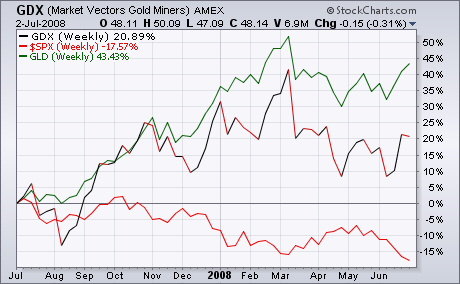
Chart 1 - Since July 2007 the S&P (red) has been moving lower and gold the metal (green) has outperformed gold equitites (red and black)
Hunting Elephants
There is no doubt that an equity risk premium has weighed heavily on precious metal equities and that stabilization in equity markets would certainly benefit such stocks. But that’s old news.
What we consider interesting and downright fascinating is the nature of gold equities investors should be focusing on over the next year.
Conventional wisdom is that the juniors are where the investment gems lie. We don’t disagree – entirely.
Over the longer term (3-5 years) the fundamentals certainly favour late stage explorers and emerging producers, but an overlooked market dynamic causes us to lean rather towards their larger cousins.
As we have alluded to above, gold stocks and other precious metal equities are equities and more often than not subjected to the same forces as the general equity market. One such force is the veritable wall of passive indexed money, by some accounts amounting to several trillions of dollars.
And what’s the passive indexed money saying?
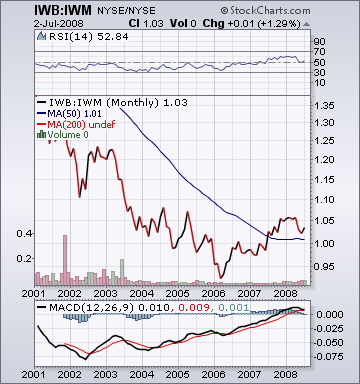
Chart 2 - large caps now outperforming small caps
Firstly, it’s saying that the long period of outperformance by small caps versus large caps (chart 2 is falling) bottomed in 2006 and the trend has since been towards large caps.
Secondly:
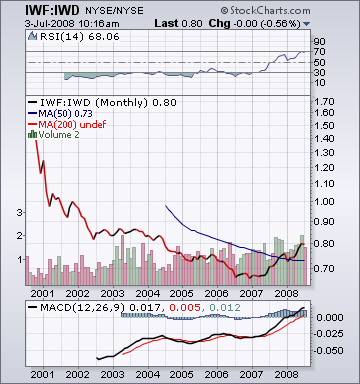
Chart 3 - large cap growth has outperformed value since late 2006
The trend in large caps from value to growth (chart 3 is falling) also looks to have bottomed around late 2006. We define growth as earnings growth of +15% p.a. and/or PEG ratio of around 1.5.
These trends resonated well with us as large cap gold producers beat out small cap miners over the last year leaving many a gold stock speculator highly frustrated.
Where to find such elephants that will benefit from these trends?
We would begin by looking at components of the Gold Stocks ETF (GDX) or the Amex Gold Bugs Index (HUI).
Monday, 7 July 2008
Crisis 2008: The Worldwide Food Shortage
For many years, we have known of the damage that the US Farm Bill and the EU Common Agricultural Policy have done to poorer non-subsidised farmers in the third world. It is an indictment upon us all that it is cheaper for a Ghanaian consumer to buy American tomatoes than those locally grown in Ghana.
We talk of the flood of Chinese goods coming into our countries when we have been flooding the poorer nations with our produce for the last 25 years.
Then just when the global demand for seed and corn begins to exceed production, we divert it away from the dinner table in order to fuel cars. The true cost of ethanol production is massive. Just consider the use of water:
From USA Today:
Ethanol is also becoming less sustainable politically. John McCain opposes it openly and Barack Obama will face pressure to do the same. In the EU, Britain has been joined by the Scandinavians in their opposition to Ethanol.
This week the G8 meet here in Japan, with world hunger on the agenda. The time has come to stop feeding our SUV's in order to feed people.
Just as importantly, welfare for major agricultural corporations and wealthy farmers must stop. Self sufficiency in food production will become more key over the next few years for the poorer countries.
Below is todays editorial from the New York Times:
Editorial
We talk of the flood of Chinese goods coming into our countries when we have been flooding the poorer nations with our produce for the last 25 years.
Then just when the global demand for seed and corn begins to exceed production, we divert it away from the dinner table in order to fuel cars. The true cost of ethanol production is massive. Just consider the use of water:
From USA Today:
"The figures cited by both Martin and Pimentel include only a plant's production of ethanol, not the water it takes to grow corn. After adding that, about 1,700 gallons are needed to produce every gallon of ethanol, Pimentel said.
The entire water-use picture, coupled with the fuel it takes to produce ethanol, makes long-term, mass production of ethanol unsustainable, Pimentel said.
"I wish it were sustainable, I'm an agriculturalist," he said. "I wish this whole ethanol deal was a major benefit, but you've got to be a scientist first and an agriculturalist second."
Newsweek reported:
In the arid regions of the American West,water has always been a precious liquid gold. But in Adamson's home of Yuma County, Colorado, two hours east of Denver, the stakes just got higher. Thanks to the boom in ethanol production spurred by green-energy concerns, corn farmers in Yuma County—one of the top three corn-producing counties in the country—are enjoying a new prosperity.But the green-fuel boom touted as a clean, eco-friendly alternative to gasoline is proving to have its own dirty costs. Growing corn demands lots of water, and, in eastern Colorado, this means intensive irrigation from an already stressed water table, the great Ogallala Aquifer. One sign of trouble: in just the past two decades, farmers tapping into the local aquifers have helped to shorten the North Fork of the Republican River, which starts in Yuma County, by 10 miles. The ethanol boom will only hasten the drop further, say scientist and engineers studying the aquifers. The region's water shortage has pitted water-hungry farmers against one another. And lurking in the cornrows: lawsuits and interstate water squabbles could shut down eastern Colorado's estimated $500 million annual ethanol bonanza with the swing of a judge's gavel. Collectively, "[ethanol] is clearly not sustainable," says Jerald Schnoor, a professor of engineering at the University of Iowa and co-chairman of an October 2007 National Research Council study for Congress that was critical of ethanol. "Production will have serious impacts in water-stressed regions." And in eastern Colorado, there's lots of water stress.
Michael Grunwald reports that one person could be fed 365 days "on the corn needed to fill an ethanol-fueled SUV". He further reports that though "hyped as an eco-friendly fuel, ethanol increases global warming, destroys forests and inflates food prices." Environmentalists, livestock farmers, and opponents of subsidies say that increased ethanol production won't meet energy goals and may damage the environment, while at the same time causing worldwide food prices to soar. Some of the controversial subsidies in the past have included more than $10 billion to Archer Daniels Midland since 1980. Critics also speculate that as ethanol is more widely used, changing irrigation practices could greatly increase pressure on water resources. In October 2007, 28 environmental groups decried the Renewable Fuels Standard (RFS), a legislative effort intended to increase ethanol production, and said that the measure will "lead to substantial environmental damage and a system of biofuels production that will not benefit family farmers...will not promote sustainable agriculture and will not mitigate global climate change."Ethanol is also becoming less sustainable politically. John McCain opposes it openly and Barack Obama will face pressure to do the same. In the EU, Britain has been joined by the Scandinavians in their opposition to Ethanol.
This week the G8 meet here in Japan, with world hunger on the agenda. The time has come to stop feeding our SUV's in order to feed people.
Just as importantly, welfare for major agricultural corporations and wealthy farmers must stop. Self sufficiency in food production will become more key over the next few years for the poorer countries.
Below is todays editorial from the New York Times:
Man-Made Hunger
To a large degree, this crisis is man-made — the result of misguided energy and farm policies. When President Bush and other heads of state of the Group of 8 leading industrial nations meet in Japan this week, they must accept their full share of responsibility and lay out clearly what they will do to address this crisis.
To start, they must live up to their 2005 commitment to vastly increase aid to the poorest countries. And they must push other wealthy countries, like those in the Middle East, to help too. That will not be enough. They must also commit to reduce, or even better, do away with their most egregious agricultural and energy subsidies, which contribute to the spread of hunger throughout the world.
In the last year, the price of corn has risen 70 percent; wheat 55 percent; rice 160 percent. The World Bank estimates that for a group of 41 poor countries the combined shock of rising prices of food, oil and other raw materials over the past 18 months will cost them between 3 and 10 percent of their annual economic output.
Some of the causes are out of governments’ control, including the rising cost of energy and fertilizer, and drought in food exporters like Australia. Higher consumption of animal protein in China and India has also driven demand for feed grains. Wrongheaded policies among rich and poor nations are also playing a big role.
Of those, perhaps the most wrongheaded are the tangle of subsidies, mandates and tariffs to encourage the production of biofuels from crops in the United States and the European Union. According to the World Bank, almost all of the growth in global corn production from 2004 to 2007 was devoted to American ethanol production — pushing up corn and animal feed prices and prompting farmers to switch from other crops to corn.
Long-standing farm subsidies in the rich world have also contributed to the crisis, ruining farmers in poor countries and depressing agricultural investment.
Rich countries are not the only culprits. At least 30 developing countries have imposed restrictions or bans on the export of foodstuffs. Importing countries are now stockpiling supplies, which takes more food from global markets. Export barriers also reduce farmers’ profits and discourage them from investing in more production.
So far there is no sign that the leaders of the developed countries are ready to do what is needed. The United States and Europe have refused to curtail their bio-fuel subsidies or their lavish farm subsidies. They are also falling far short of their aid commitments.
At the 2005 G8 summit meeting, leaders said that by 2010 wealthier nations would increase annual development aid to poor countries by $50 billion. Yet aid has increased by only $11 billion. And there is suspicion that the G8 nations, who were to provide the lion’s share of the increase, want to wiggle out of their commitment.
We welcome President Bush’s pledge to provide $5 billion this year and next to “fight global hunger,” but much more must be done. The United States remains the stingiest of rich nations when it come to foreign aid.
In a letter to heads of state of the G8, Robert Zoellick, the World Bank president, estimated that the bank needs $3.5 billion to provide immediate food aid and seed and fertilizer in poor countries. The International Monetary Fund and the World Food Program estimate they need $6.5 billion more in the short term to help feed vulnerable populations. This does not even count the need for essential longer-term investments to increase farm productivity in poor nations in Africa and elsewhere.
As Mr. Zoellick wrote, the food crisis is a test of the world’s willingness to help the most vulnerable. The leaders gathered in Japan must rise to the challenge.
Subscribe to:
Posts (Atom)